
6th November 2023

Listen
Listen
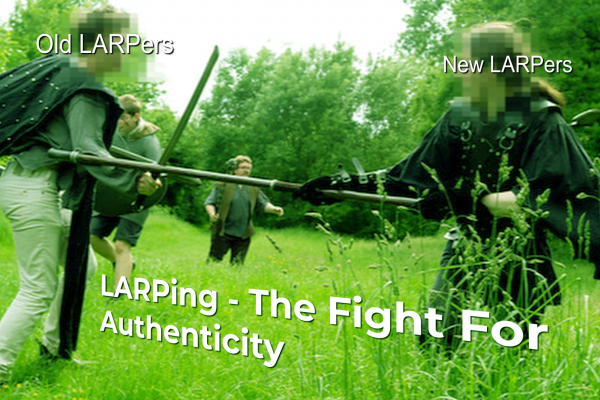
If you’ve been as chronically online as I have been for a while now, you may have noticed the term ‘LARPing‘ (Live Action Role Play) appearing rather frequently. Often found in comment sections (especially on TikTok), this alongside the concept of the Dead Internet Theory, have begun dominating digital discourse.
Now, LARPing – or larping – is a term that has undergone what linguists would call a semantic broadening; in other words, the term itself has already existed but its definition has expanded beyond its original scope. If you were to ask someone a decade ago what LARPing was, they would likely tell you that it is a form of roleplaying between groups.
From this, individuals would mimic characters (either exactly or of their likeness) from a media text and use real environments to recreate the same immersion.
The term LARPing has existed since the 1970s, with it relating to RPGs (Role-Playing Games). In Marjukka Lampo’s 2015 article Ecological Approach to the Performance of Larping, she cites Jaakko Stenros’ notion that larps are “like improvisational theatre without an audience that is performed for its own sake, rather than performed for an audience” (2010, p. 313).
Moreover, she cites Eleni Timplalexi’s (2011) belief that larping is a “process in which the players mediate imagined, iconic fiction through the performative” (p. 35).
In the following video above, VICE define LARPing in their description as “a game in which people create characters and act out storylines within fictional worlds, in real time, in costume“. Like most terms, the definition of LARPing still varied back then.
The video’s primary focus is on Jon Gallagher, a LARPer with Asperger’s, who describes the process as “not a game…not an interactive drama…not a play. It’s not performance. This is a world” [0:48-1:00].
Disclaimer: My thoughts from this have been largely derived by saintdon’s video ‘LARPing 101‘, linked here
Now, if I were to ask someone now what LARPing is, they would say that it is “to accuse someone of pretending to be something they’re not”. It has been weaponised as an insult to describe someone as insincere and fake, who deceives others for their own interests. Mainly, for validation.
And to be honest, it makes sense. You can LARP a humble and nonchalant persona, but we all care about other people’s opinions, whether we show it explicitly or not. People are trapped in this tug of war, wanting to fit in but then also wanting to carve out their own identity.
Another slang term for this could be the idea of a ‘pick-me‘, a term which mostly was targeted at women via stereotypes, but is applicable to any gender. Or the term ‘poser’. Compared to the ‘original LARPers’ who devote their time to role-playing out of genuine passion, these new LARPers will roleplay social interaction in order to be seen.
The best example I can think of this stems from my A-Level Media lesson on audiences. Specifically, Young and Rubicam’s 4Cs psychographics model in its 2010 definition. Their model was first designed to understand people’s motivations for buying certain brands, segmenting buyers into 7 distinct types. For this, we only need to consider that of aspirers. These are people that seek glamour and materialism, choosing brands that improve their public persona.
Consider videos of people bragging online about a new car they just bought, with them showcasing their purchase through a TikTok post or an Instagram story. If they continue to push out content similar to this, then odds are that they may be the new LARPers in the eyes of the mainstream. But, we cannot be entirely sure if people own these items or are simply renting them, with the latter suggesting this new inauthenticity that everyone is pushing back on.
Now, not to confuse this with flexing, since LARPing emphasises performativity, whereas flexing is bragging about something which someone may actually have (e.g – a rich person showing off their brand new mansion which they do own would be flexing, not LARPing).
Let us apply this to fandom and media. LARPing now accommodates for those who pretend to be knowledgeable about something, when in reality they know very little or next to nothing. This relates back to my original discussion of anti-intellectualism back in February, linked here.
The new LARPers are partaking in what Thomas Pearson’s TikTok (linked here) described as the “Dunning-Kruger Olympics”, suggesting that people are competing for the chance to be deemed far more intelligent than they really are. Everyone in the world is lacking knowledge in some area, especially in a world like this where there is more information – and dis/misinformation – than we know what to do with.
This section was mainly out of self-interest but I wanted to dedicate a portion discussing how LARPing has infiltrated video game fandoms.
For this, we can see evidence of gaming LARP through that of the Resident Evil franchise. A recurring discourse I have witnessed take place both online and in-person is the dichotomy of old vs new Resident Evil. For reference, the old version is that of fixed camera angles and tank controls (having to rotate a character on an axis and then push the stick forward); e.g – RE1. The new version is over-the-shoulder, third person and/or first person perspectives (e,g – RE9).
Of course, there are exceptions (e.g – The Darkside Chronicles plays as an on-rails shooter | think of arcade games where you shoot enemies and are moved forward to the next levels) but these are the main blueprints that have defined what Resident Evil should be experienced like.
The fandom itself can’t agree on a definitive preference, which is understandable in a franchise that has shifted its identity from true survival horror to action horror to full blown action. Then, a return back to its roots. I’ve seen people comment about how much the older games are what the franchise’s future would be and then realising they’ve never played the older games.
Perhaps they may have watched someone’s playthrough but video games as a medium require active engagement and passive consumption doesn’t achieve the creator’s intended vision. Even with how modern games have a large portion dedicated to cutscenes, sometimes these cutscenes will have QTEs (Quick Time Event) or require players to make choices to progress; e.g – The Quarry, The Last of Us Part 2.
As an RE fan, I was introduced to the games through being aware of RE4 through 6. Although, I never actually played any of the games until RE7 but only finished my first ever game with the RE2 remake. Just not really a fan of first person games. From this, I played RE3 and RE4 remake, with me hesitating at first in playing the latter due to perceiving it as potentially overrated.
I do admit this judgement was clouded by my disappointment with the RE3 remake, especially when compared to how much I loved the RE2 remake. But RE4‘s remake truly was as good as people had claimed, with me repeatedly replaying it a fair few times. I have also played RE5 and RE6, which are certainly interesting games in their own right (RE6 is genuinely a bad game though).
More recently, I tried out RE3: Nemesis on my PS5 using their backwards compatibility, with it taking me a bit of time to get used to but I have enjoyed what I’ve played so far. But I do prefer modern Resident Evil. Does that make me a LARPer? I don’t think so.
Although I do like that the term is calling out people who are sycophants, I have also noticed through my own experience that the term can discourage people from enjoying media texts. For instance, I found myself scrolling on TikTok a few days ago and commented on a GTA 6 post about Lucia Caminos, one of the new protagonists alongside Jason Duval. In this, I mentioned how glad I was that the franchise was getting a female protagonist.
However, I received a reply that accused me of being a LARPer and that the original top-down GTA games had female protagonists. This is something I don’t understand. While it was bold of me to state that GTA had never had a female protagonist, this conclusion was made due to the lack of coverage regarding GTA female protagonists (GTA Online characters I wouldn’t personally count, since these aren’t prewritten and are made as a blank slate for player projection). It was also partly due to my only playthroughs being within the 3D and HD universe.
Now, one could argue that due to the echo chamber that is my own personal viewing experience, how could I expect to see anything about this without already being aware of it? Well, that isn’t how content algorithms work. While it is true that they will show you content that you like, the goal is to recommend new content and identify not only what a user likes but also what content is suitable for the platform (think about TikTok’s occasional prompt of “What are your thoughts on the video you just watched?”).
You search up the term ‘GTA protagonist’ on YouTube and I guarantee you, you won’t find a female in the thumbnail. Is my lack of knowledge regarding two older games I’ve never played make me an overall Grand Theft Auto LARPer? Who decides that to be the case?
That anecdote is part of a grander concern I have with this new LARPing approach: are people who try to develop interests in media fake and inauthentic for not knowing something truly diehard fans would know? Do casual fans deserve the title of LARPer? How do we manage people that forget facts and are accused of LARPing? Should people even pursue an interest in anything if they risk being called one?
These questions are ones that race throughout my mind whenever I engage with online content because I worry how easily misguided this term can become. People should be more comfortable with not being aware of something and be willing to learn. At the same time, there is the fear of being judged due to not being aware of something that appears normalised.
So, here we are. I’ve managed to LARP my way through this article as a competent writer who knows what he’s talking about. Maybe. I guess that is up to you to decide. All I know is that I hate the new definition of LARPing.
Cosplaying isn’t my forte but I’d take that over being chastised for fandom trivia or accused of being fake any day. I like what I like and no one will take that from me. I will also embrace my fake nature as I please.
If you’re also suffering from the Dunning-Kruger effect like me, then I suggest that we both go see a psychiatrist.
For more info on LARPing from a reliable source, check out Know Your Meme’s article here.
What do you think? Feel free to email me at johnjoyce4535@gmail.com!
Follow my TikTok and drop me a message – jjoyce4535
Check out my last article: Academic Reboot – My Experience As a First Year Student
Or check out my website! Published a blog a while back called Linguistics: 101, serving as an introduction to linguistics.
For more about arts & culture, check out the following link:
https://www.liverpoolguildstudentmedia.co.uk/category/arts-culture