
6th November 2023

Listen
Listen
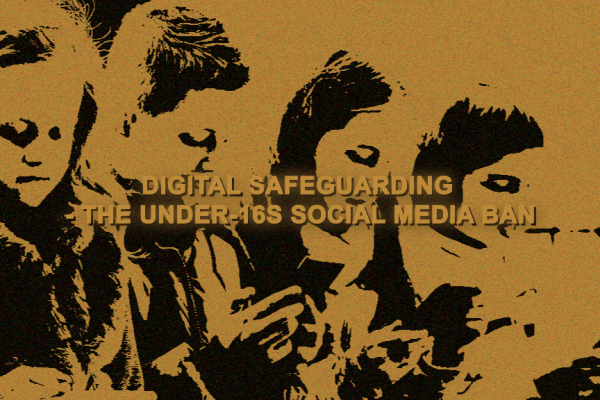
So, I’m sure you’re all well aware that the (now former) Prime Minister has recently announced a social media ban for under-16s. I’m sure you’re also aware about the viral BBC clip of a girl with big dreams regarding her spare time: staring contests with walls.
Here is an edit of her made by @daviiedits0, linked here. Personally, made me laugh quite a bit. Would love to see her reaction posted somewhere.
These restrictive measures will be implemented in early 2027, acting as a means to ensure that children are protected online. The ban has been largely influenced by not only a growing concern for online safety but Australia’s decision in creating their own banning model.
The following apps will be banned:
Before we get into what is planned for young UK citizens, we must take a look back on Australia and their decision-making process.
According to UNICEF:
This ban was possible via the passing of a new law on 28th November 2024, known as the Online Safety Amendment Bill (Social Media Minimum Age). Legislation requires users to be 16 for social media access, with parents being forbidden from providing user consent. The bill’s purpose was to modify 2021’s Online Safety Act, requiring certain social media platforms to implement countermeasures in preventing under-16s from access.
However, platform restrictions have existed before. Generally, children under 13 cannot sign up for social media, since many global platforms conform to the United States’ Children Online Privacy Protection Rule, or COPPA – Australian regulation didn’t really enforce this. But these restrictions can be bypassed.
Australia’s government enforced this ban in order to protect its younger citizens’ mental health and wellbeing; they believed that social media’s risks (e.g – cyberbullying, predators, sensitive content) surpassed the benefits.
The new law being introduced is a response to protecting children online, safeguarding them from potential threats. Furthermore, the law is a means to resist big tech giants’ domination of the digital realm and their avoidance of regulatory action. Although online media is hard to legislate, regulate and enforce, this is certainly a bold step designed to structure the loose nature of the Web.
And although I will go on to discuss criticisms, I do respect this action being taken, as it means there will be something to prevent organisations from avoiding responsibility and using our data for ill-gain.
Beyond this, gaming services and live streaming platforms will also face legislative action to ensure greater child protection (e.g – Starmer alludes to Omegle by saying how strangers can contact children online without checks implemented | 5:59-6:05). In addition, the Online Safety Act has given the government a framework to apply age verification techniques (e.g – Photo ID, credit card checks, email-based age estimation).
This is regulated by Ofcom, with more info about age verification methods linked here.
The one thing that stood out to me during Starmer’s broadcast from 10 Downing Street was that the law would provide “real change for our children and our future” (0:06-0:10). Another notable statement was “I am not prepared to compromise on the safety and happiness of our children” (4:35-4:40).
He goes on to announce the government’s plans to ban all social media for under-16s. The decision wasn’t a light one, and he states his recognition of the potential ramifications from this, albeit from a parent’s perspective. Now, I understand why he did this. An anecdote helps build up his sense of ethos to that of his generation.
But in doing so, it alienates the ones who are actually affected: under-16s. He does later on try to sympathise but I think the main focus is on that of parental concerns. I did like his addressal of the attention economy too and that of infinite scrolling. Furthermore, the mention of going to bed early was a fair point but I think this is more of a technology concern rather than simply social media, but I do agree that it plays a role.
I agree with his mention of online media’s challenges and how this hasn’t been an easy choice. Digital legislation, regulation and enforcement of said legislation has always been a complex matter, due to the enormous array of websites and companies that are on the Internet.
Once Kier finishes his speech, Sky’s political editor Beth Rigby asks Starmer about potential concerns regarding US big tech companies and Trump’s reaction to this new law; she refers to their eventual meet-up at the G7 summit (an annual meeting between Canada, France, Germany, Italy, Japan, the UK and USA; in this, they discuss global economic, political and security concerns).
From this, he states his pro-tech and AI stance, referring back to his speech at London Tech Week, linked here. He affirms that one can be pro-tech and also pro-child-protection, while also remarking that big tech companies have just as much responsibility as the rest of us to protect younger users. To him, social media’s impact is one of the biggest political discussions which needs to be had.
Now, I am someone who grew up for most of his childhood without the Internet, instead watching TV and going outside to play with my friends. But I did always have an interest with digital media, particularly the mediums of film and video games. Social media expanded my love for media texts by enabling me to dissect these products and educate myself on their fandoms.
Overall, there are some sweeping generalisations made which will be addressed here:
Now, let’s be honest. When we were all younger, we probably made a social media account lying about our ages to get onto the platforms. I know I certainly did once I got access to the Internet. Who is to say that people won’t end up continuing to do the same thing once the ban comes around?
Especially when it comes to keeping updated with that of politics and culture? Many people prefer to watch videos over reading lengthy articles such as this, and the under-16s will be forced to resort to platforms such as YouTube Kids until they become of age. Will under-16s be given the same care and coverage of political stories to that of those older than them?
I do think parental discussion around their children’s social media usage should be carried out within all families, particularly in a time where technology persists in its acceleration. Improved child locks via screen time monitoring and parental decision-making on perhaps content filtering would be a far better step than a simple ban.
These platforms have been mandated to verify the ages of users on their platforms. To do so, information must be shared. Sensitive information which the company must be entrusted to preserve and protect from potential data breaches.
Personal data is a part of our identities now when we traverse the online space and many won’t be willing to share their information with private companies. Despite data protection laws requiring companies to use the data ethically, who can determine if our data isn’t being sold to third-parties?
Something I have seen people misconstrue is that this law is a form of user censorship, concealing content via restrictions. While definitions of censorship can vary from person to person, I believe that censorship is where content cannot be easily accessed by anyone but a minority. When these individuals become of age, the expectation is that content can be found without age verification. Thus, I don’t see it as censorship.
Think of alcohol and cigarettes. Is it censorship for younger people to not already have legal access to these substances before they are of appropriate age?
At the same time, young creators are limited in their audience reach, since they cannot easily publicise their work without loopholes of some sort. These individuals can no longer act as a role model for other people around their age and teach them new skills; after all, people prefer to watch things which align with their interests and sense of character.
Removing that choice entirely will I imagine have a huge impact on social media marketing. Now, not every young creator is posting positive content in the typical sense, but the ban means that those who are will be forced to accept the new reality.
Let us consider that of the academic literature and studies comparing addiction and social media; for instance, Paul W. Bennett’s Weapons of Mass Distraction, where he reflects on how children’s screen time “spiked during the COVID-19 pandemic” (p. 13, 2024). Moreover, Bennett cites a Canadian study from April 2023 by JAMA Pediatrics, who identified that children’s screen time (concerning non-school purposes) had caused a greater digital dependence.
At the same time, Smith and her colleagues (2021) identified through their research that social media can be a benefit for groups such as autistic people. Here, social media acted as an outlet for their social interactions, with the primary function being to maintain friendships (p. 4). Although, they did also address how many interactions would be abusive and that autistic teenagers were more subject to bullying (p. 5)
So, there is evidence to back up Starmer’s demands of wanting to protect children online.
It’s a complicated, uncomfortable situation that has sparked lots of discourse. I wish I could say that this is something with a clear answer but both sides of the discussion have merit to them. Personally, I think that a ban is a bit extreme and we should work more on social media safety through greater regulation. Perhaps this is a means to do so but I can only think about how ineffective this law could become.
I would recommend you read up on this matter, as although you may not be 16, you will have to verify your age once this law is a part of our everyday lives. In other words, another part of your identity being given away to third-party companies.
For now though, make sure you keep up with this event, as it is a growing conversation we need to keep on having.
Update (22/06/2026): As of writing, Kier Starmer has resigned as Prime Minister, leaving me even more concerned about this new law’s integration and who will take the reins of fulfilling the ban’s objectives.
Check out the BBC’s full transcript of his video here.
Also check out this video of his resignation speech here.
What do you guys think? Feel free to email me at johnjoyce4535@gmail.com!
Follow my TikTok and drop me a message – jjoyce4535
Check out my last article: Cocky Espionage – Reviewing 007: First Light
Or check out my website! Published a blog a while back called Linguistics: 101, serving as an introduction to linguistics.
For more news stories, check out the following link: