
6th November 2023

Listen
Listen
The following photo was captured in an Instagram comment section concerning GTA 6, posted by the official Rockstar Games account (post link here):

As you can see, the user repeatedly spammed the disc emoji, alluding to their dissatisfaction with the upcoming cultural shift of media; that being the discontinuation of physical media products, an agenda being pushed by Rockstar and Sony. Now, I’m sure for both many gamers and non-gamers, this may not be a huge concern.
But for a lot of people, this highlights another means of removing consumer choice by taking physical copies out of the equation.
However, this shift isn’t all that surprising.
According to Statista, this has been the evolution of the UK’s entertainment retail sales since 2014:
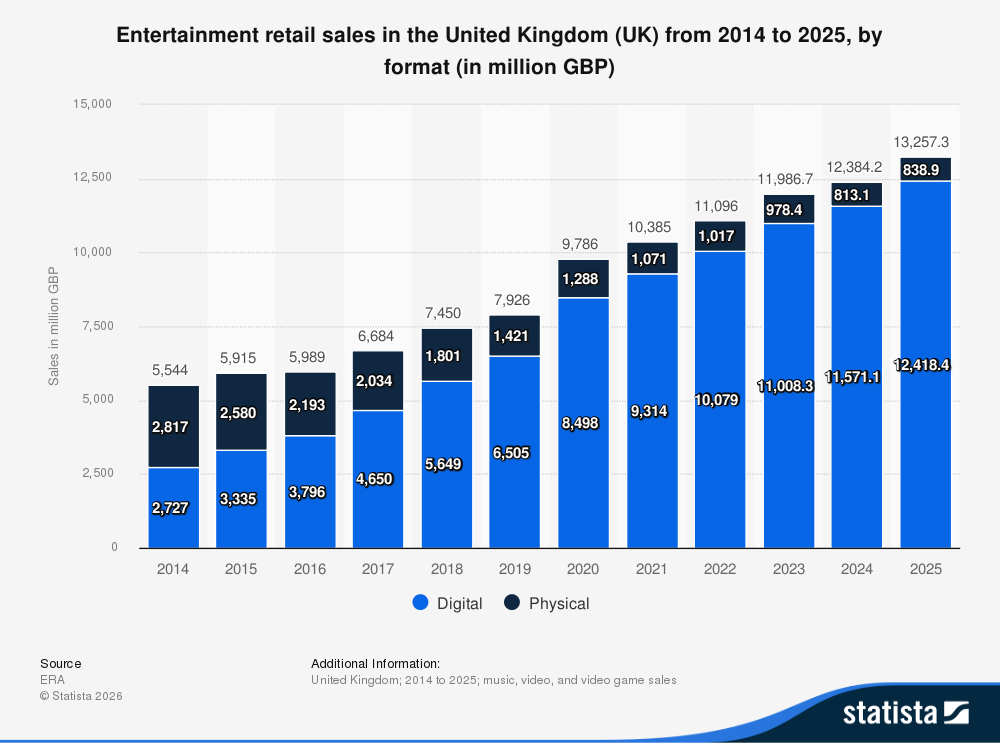
As we can see, last year saw digital sales generate £12.4184 billion, whereas physical media only generated £838.9 million.
For more info about this, check out the statistic’s original source of the ERA, linked here.
This is a great thing since it means that media industries are flourishing and we can keep getting media we enjoy. But it also means that we can only receive said media in a digitised format.
Regardless of the pros which come with digital media, physical media is something that should be preserved – in my opinion – for as long as possible.
Yesterday, Ubisoft CEO Yves Guillemot downplayed Sony’s decision to stop producing physical discs for PlayStation; we can see this within Ubisoft’s Q1 fiscal year 2027 earnings conference call, with a transcript linked here. Additionally, here is the link to Ubisoft’s official audio recording of the conference (required to sign up).
TD Cowen‘s analyst Doug Creutz asked the following:
“Sony recently announced that they’re going to discontinue physical disc-based games as of 2028. Just wondering from your perspective if you have any concerns that that could create a demand headwind (challenge/obstacle), either directly or perhaps indirectly, because it prevents gamers from recycling games to the used game market and then using that to purchase new games. Thank you.” (21:12-21:38)
From this, Ubisoft’s CFO Frédérick Duguet replied:
“What we saw on the PC is that it helped to grow the market. There’s also some pressure for the future on the cost of machines, being able to be only digital will help to have a more accessible machine, I would say. As you said, there are plus and minus, but we think it will not disturb too much the industry.” (21:39-22:12)
To get an expert opinion on the matter, I reached out to one of my lecturers Dr Christopher McMahon to get his thoughts on the circumstances; this is what he had to say:
I have been working on a project called Noisy Gaming on the potential benefits of shared physical gaming spaces, and part of what motivated that was the increasing immateriality of games and gaming culture. Consoles and games themselves appear to be moving towards online-first platform-based structures and that is affecting what types of spaces videogames can produce. The ability to share discs or cartridges was a big part of growing gaming as a shared and cooperative experience.
The potential absence of physical gaming media impacts us in a few ways, from more abstract notions of ownership and control of one’s own things to very concrete media preservation concerns. I think the direction of travel towards digital only gaming is concerning.
Moreover, I also contacted Programme Lead for BSc (Hons) Game Design Thomas Owens (who specialises within level, environmental, puzzle and encounter design, alongside 3D modelling and animation) to provide his perspective:
The focus on physical media is a bit of a red herring, in my opinion. The real concern is in how users can access, use, and store their purchased games. The film industry has gone through a similar process with physical media (VHS/DVDs) being almost completely replaced by streaming and downloads with little complaint from users. The complaints started to emerge when the providers start to restrict user rights, Netflix changing their policy from allowing account sharing to adding strong restrictions as one of the biggest examples.
To take it back to games, Steam has had relatively mild criticism despite being almost entirely digital as the service it provides and the hands-off approach to account sharing (Steam Families allows multiple accounts to share games) improves the user experience. GOG is a platform that allows users to download the installation files of a game, DRM-free.
These platforms demonstrate that games can be sold digitally while still allowing users to access, use, and store their games with friends and family and/or offline. That being said, this does mean that collectors and second-hand sellers will be limited in what they can do.
I asked him some other questions to further develop this inquiry into the shift towards digital-centric game development:
Here is a link to the current Liverpool MPs, in case you do decide to reach out; if you don’t live in Liverpool and are unsure who your local MP is, use this website to check.
Now, unless you’ve been living under a rock, I’m sure that you are well aware that Grand Theft Auto 6 is releasing this year on November 19th. The release of the game itself is something almost absolutely everyone is excited for. The issue stems from their means of distribution: a digital-centric approach that leaves behind console gamers who prefer physical copies.
Ironically, despite PC games not receiving a disc copy in several years, these gamers are the ones who have received no confirmation regarding a desktop version of GTA 6.
This is what Rockstar stated in their newswire article on June 24th, the day before pre-orders were made publicly available:
Players who pre-order digital versions of Grand Theft Auto VI will be able to begin pre-loading on November 12 to ensure they are able to play at launch on November 19. The physical version of Grand Theft Auto VI, containing a download code inside the box, will be available starting November 12 to support pre-loading.
As you can see, zero mention of a physical disc, instead substituted by a download code similar to a gift card voucher which users can enter into the console’s built-in digital store. So, in essence, you can either buy it digital now or digital later.
Now, I’ve only ever pre-ordered a game twice; both instances were physical discs at the store GAME. These games were Watch Dogs: Legion and Resident Evil 3 (2020). Therefore, I have no experience with digital pre-orders. I will still buy GTA 6 but I am very disappointed that there is no true physical counterpart.
Allow me to explain why digital games are problematic. I’m sure you may already know this but Xbox, PlayStation, Nintendo all have the capacity to remove your access to their digital games. At any time. This is a huge argument made for why physical media surpasses digital: tangible, unlimited ownership.
For example, when Batman: Arkham Origins was delisted on digital console stores, many gamers like me purchased the Xbox 360 version and played it on the newest Xbox console via backwards compatibility.
Check out this video of Sony’s conference back in E3 2013, where they discuss the importance of discs on the PS4:
As you can see above, Jack Tretton (former CEO of Playstation’s American branch) says that a gamer who owns a PS4 disc has the right to use the copy of that game. To trade it in to retailers, sell to others, lend to friends [and family] or preserve it forever within their collection.
Compare this to now.
For instance, PlayStation recently announced that due to content licencing agreements with Studio Canal, previously purchased content will be removed from users’ video libraries. Not a refund but a blunt removal. This happened back in 2022, where they removed Studio Canal films and TV shows within Austria and Germany.
Additionally, in 2023 via Discovery Videos, accompanied by an announcement. However, they changed their minds and secured another 30 months for users to access Discovery’s content (the end of said 30 months was in June this year).
If you go on any game within your PlayStation library and press the Options button, it will say “Restore Licence”. Locally stored on your console, these licences are what allow you to access the purchased games, alongside potential DLC (Downloadable Content) or even movies. Not own, but to have eligible access.
If you don’t believe me, PlayStation’s Terms of Services state the following in Clause 13 ‘Shopping on PlayStation Store’:
13.5: When you purchase or download a digital product:
13.5.2 You can use a digital product in the ways described in the licence but you do not own the digital product
They inform the PlayStation Network’s servers that you have ownership over content purchased or downloaded from the PlayStation Store, connected to your PlayStation Network account to give you appropriate access. This is done to ensure that you and only you can use the content that you’ve bought (well, unless you game share with someone, which can confuse the PSN servers and require you to restore your licence).
More recently, in March, PlayStation adjusted their DRM (Digital Rights Management) requirements for games purchased from the PS Store: if the console doesn’t receive an internet connection within 30 days, the licence expires and the game may not launch; what happens is the purchased game receives a temporary licence and connecting to the Internet converts said licence into a permanent one.
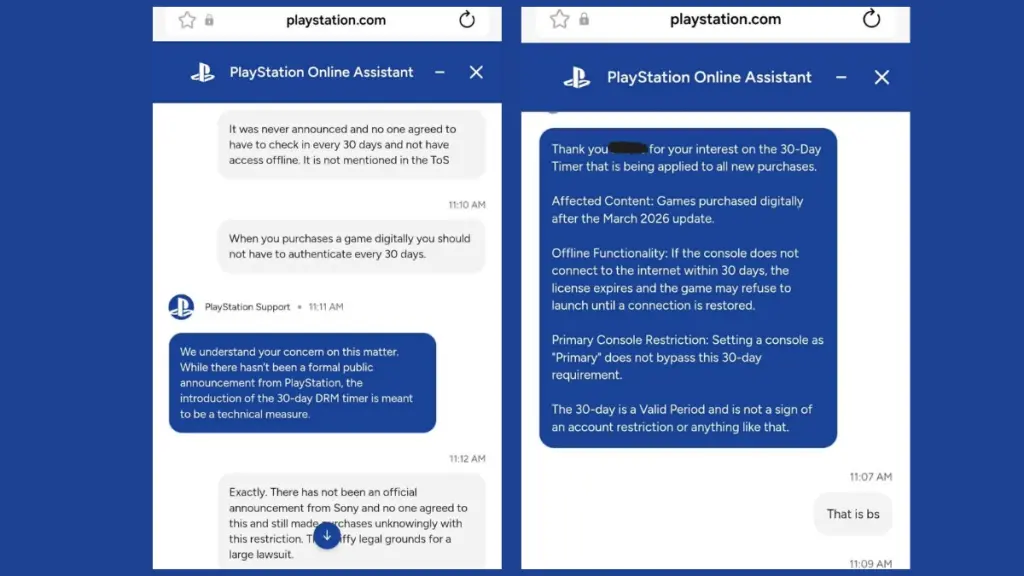
Part of the benefit with PlayStation in my experience has been the opportunity to play both physical and digital games when online and offline. This policy means that if a gamer is away from their console for 30 days and returns, they may see their licence for said game be revoked.
Contrast this to the E3 2013 conference I addressed earlier, where former CEO Jack Tretton said that an internet connection would not be required to play disc-based games (1:58:40-1:58:44); while the above is discussing games purchased on the PS Store, gamers should be allowed to play these games if they lose internet connection. Tretton added onto this by saying that the PS4 wouldn’t “require you to check in online periodically” (1:59:00-1:59-07).
The reason this was so significant was due to the ‘NO DRM PS4’ campaign back in 2013, with Gameranx’s article about it linked here.
Fast-forward to the PS5 and now we have DRM checks that potentially lock out user access. I understand that piracy is now a much greater issue but there are alternative solutions: integrity verification, anti-debugging techniques, game patches, even basic user authentication?
What happens to gamers that may perhaps live in a coastal area and lose their access to internet due to a tsunami? An extreme example perhaps but one’s living conditions can change dramatically and so Sony should accommodate for that to improve customer relations. What if one suffers from an internet outage because their ISP (Internet Service Provider) is experiencing issues?
According to BeeBom’s article, they speculate that the reason for this DRM was to combat refund scams and licence exploits on jailbroken consoles. That, I do understand. But this, combined with the new announcement that Sony’s physical disc production is ending after January 2028, is limiting overall consumer preferences by forcing gamers to migrate to online copies.
We know why digital console manufacturing has become the norm, just as we know why print media is declining: to save money on material costs. And in the case of games, to remove the second-hand market competition.
If you take a look at most games nowadays, the subscription paywall model has become a staple of game commodification practices; e.g – GTA+, Fortnite Crew. These memberships guarantee a maintained revenue stream for these companies. I honestly don’t like these, since as a console player I am already paying for both Xbox Game Pass and PS Plus subscriptions. The last thing I need is another means of money being taken away from me monthly.
Van Crombrugge and Stremersch’s (2025) research into the rise of the subscription model within the video game industry did find that it had a largely positive impact on the console platform’s overall performance (p. 1075); this implies that Sony and Xbox will continue to push this approach for as long as possible.
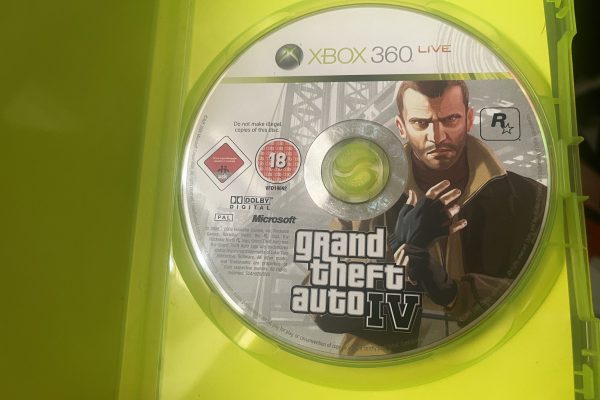
Another major issue with this is the lack of incentive for true game collection. As a child, I loved collecting the physical copies of games, since we didn’t have the Internet and I became used to buying discs at retailers. You can see in the thumbnail my disc copy for GTA IV, which I use when playing it on Xbox Series X.
When I was younger, going to shops such as Granger Games, GAME and Cash Converters with my dad and brothers was an enjoyable experience; window-shopping potential purchases, checking out old or new releases and keeping an eye out for special disc editions. Do you remember when games had booklets that often contained redeemable codes or instructions? Seems like a long forgotten aspect of game distribution.
I still remember the time where I found the Platinum edition for the original Assassin’s Creed. It had this grey outline on the cover and felt very retro-inspired, which gave it character. With the new digital-centric approach, gaming retailers like CEX I imagine will struggle financially to stay open. In fact, stores like Granger Games and GAME (which used to be in my town) have been replaced by other stores.
A big aspect of these newer consoles that have appealed to me is the opportunity to play older titles that released on former generations (e.g – PS4 games on PS5, Xbox’s diverse compatibility options). Now, I wonder that when the PS6 and whatever console Xbox releases next, will they provide backwards compatibility in the same degree? Will the next consoles be exclusively disc-free? That’s not something I’m sure that I am ready for.
Now, what is the future of discs? I imagine it will be similar to vinyl collections; a limited luxury which makes us reflect on former times. So, the value of your physical discs may become more valuable. But it means once they’re gone, they’re gone.
A completely disc-free world sounds scary, especially when the games we adore are threatened to be lost forever. All I can say is that you should hold onto the discs you still have, as I imagine that it won’t be long until DVDs and Blu-Rays follow suit.
Finally, I want you to consider Sony’s tagline of “Play has no limits”. A correction here would be that “Pay has no limits”, since these companies are more than willing to sell you their products and revoke it at a moment’s notice.
I want to finish this article off by saying thank you to Chris and Tom for getting in touch with me; this article took a long time to write but is something I feel very passionate about, both as a gamer and as a lover of media. My hope is that it isn’t too late for us to reverse this change.
Links I would recommend:
What do you think? Feel free to email me at johnjoyce4535@gmail.com!
Follow my TikTok and drop me a message – jjoyce4535
Check out my last article: LARPing – The Fight For Authenticity
Or check out my website! Published a blog a while back called Linguistics: 101, serving as an introduction to linguistics.
Moreover, I’ve also started dabbling in music, albeit nothing too crazy: johnnywonny07 (Soundcloud)
For more about arts & culture, check out the following link:
https://www.liverpoolguildstudentmedia.co.uk/category/arts-culture