6th November 2023

Listen
Listen
So, you’re thinking about a trip to Vienna. You’ve probably started looking at what to do, where to eat, and where to stay, so here’s my take. I spent a few days there in April, and this guide covers what I did, what I’d recommend, and how to do Vienna on a student budget.
Although Vienna seems like an expensive city, you can find cheap places to stay. The city is broken up into districts, with district 1 (Innere Stadt on maps) being the most expensive as it’s the oldest part of the city and close to many of the major tourist attractions. I stayed in Wombat’s, a chain of hostels with locations across Europe. It was the perfect location for me – a couple of minutes away from a metro station, across the road from the Naschmarkt (a large food market) and about a 10-minute walk to the Innere Stadt. They offer private rooms, 4-bed and 8-bed dorms, with the option for a female-only 4-bed dorm (where I stayed). I booked about a month before I went and the prices are really reasonable, so it’s definitely worth taking a look at.
Vienna has so many different things to do, ranging from museums to galleries, from churches and cathedrals to a massive funfair. It can be quite hard to narrow down what you want to do to fit your timeframe and budget, so focus on what you actually want to do and see, not just what people recommend online (I say as someone recommending things to do). I’m going to tell you what I did and whether I think it was worth the cost or not. All the prices are with student discount where that was available.
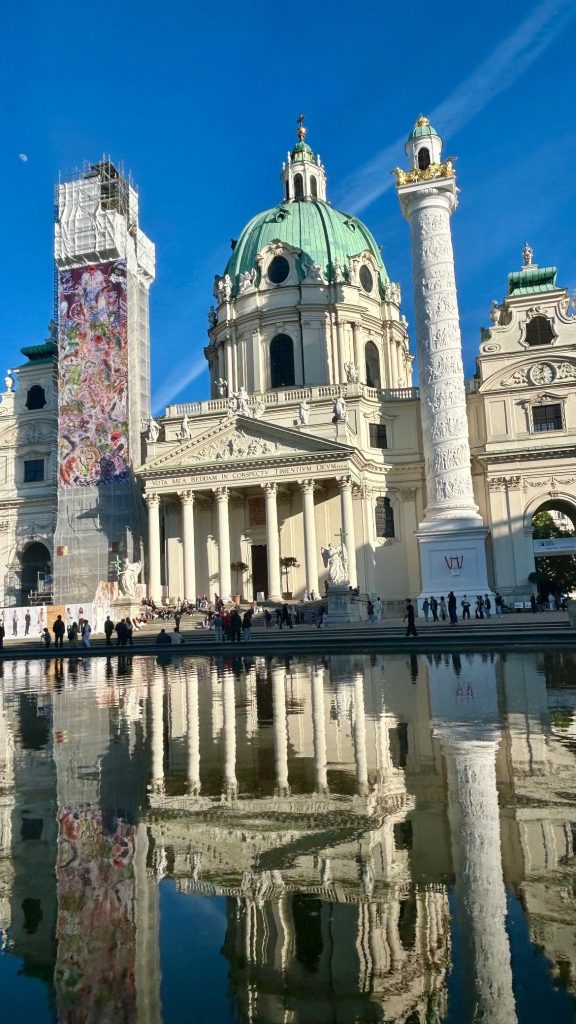
St Charles Church (Karlskirche)
Entry to the church itself is free, but I paid €6 to get entry to the treasury, model of the church, organ loft, and panoramic viewing terrace over the city. My opinion? The church itself is beautiful but I don’t think it’s worth paying the extra money. The Wien Museum right next door (see below) has a terrace with practically the same view plus you get to see the church.
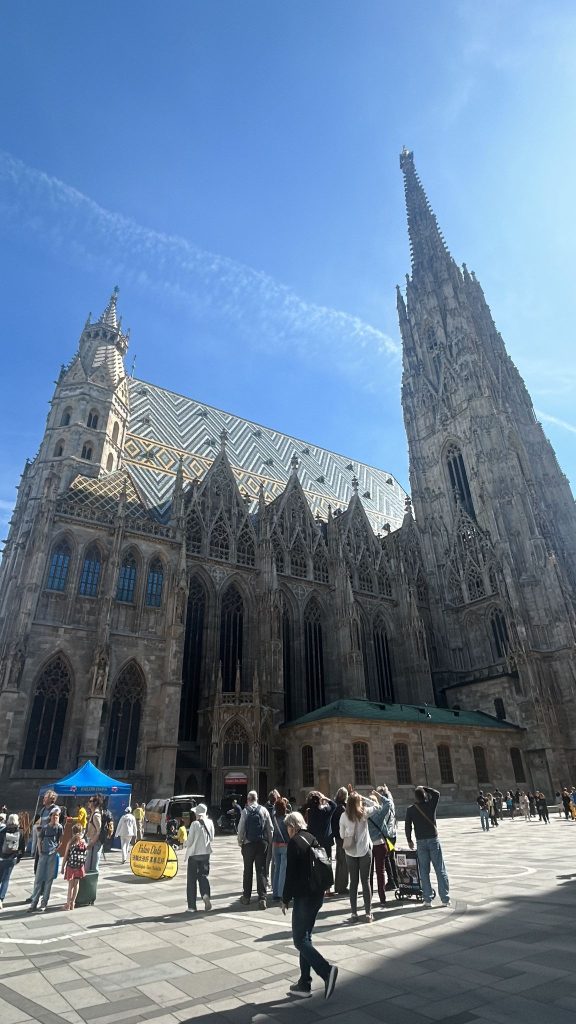
St Stephen’s Cathedral
It’s a gorgeous cathedral that is one of the iconic sights of Vienna. Entry to the back and side of the church is free, with other extras you can purchase on top including an audio guide, the north tower, the south tower, the catacombs, and the cathedral museum. These extras cost €8 each with no student discount available. The cathedral is cash only. I saw the free parts and it was nice to see, but I’ve climbed a decent amount of church and cathedral towers and €8 is pretty steep considering you’ve got to climb 343 stone steps to get to the top.
Ringstrasse tram
The Ringstrasse is the road that encircles the Innere Stadt. There used to be a tourist tram that would go along it but this was discontinued. However, there are guides online that give you a route to use and even point out what sights you can see during the ride. This costs €3 if you buy a ticket via the app, or €3.20 if you buy a paper ticket. In my opinion this is 100% worth it. You see a lot of the main sights like the Natural History Museum, the Parliament, and the City Hall from the comfort of a nice air-conditioned tram. Sit or stand near the back for the best view. It’s a great thing to do when you first arrive or the morning of your first full day as a way to work out where things are in the city.
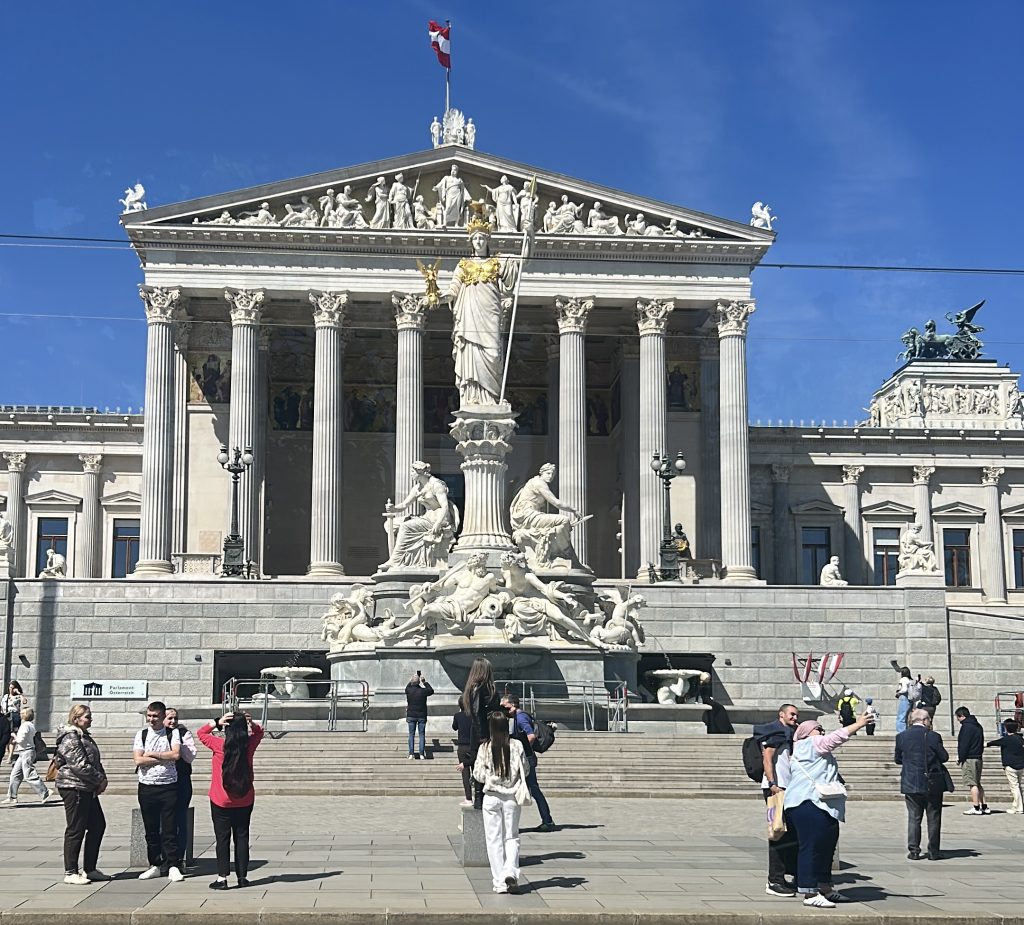
The Austrian Parliament Building
This was the highlight of my trip! Anyone can enter the Parliament building for free, you just need a valid ID and to pass through a brief security check. There is a free exhibition all about the history of the Austrian Parliament and how it works, along with a rooftop terrace giving you a nice view of the Hofburg. You can also book onto a free English guided tour of the building where you get to go into the chambers and hear more about the history of the building. They also offer architecture tours for people who are more interested in the best places to take photos from. If you love history and/or politics, this is a must-do for your trip. Just make sure you book the tour in advance as they book up very quickly.
Imperial Treasury
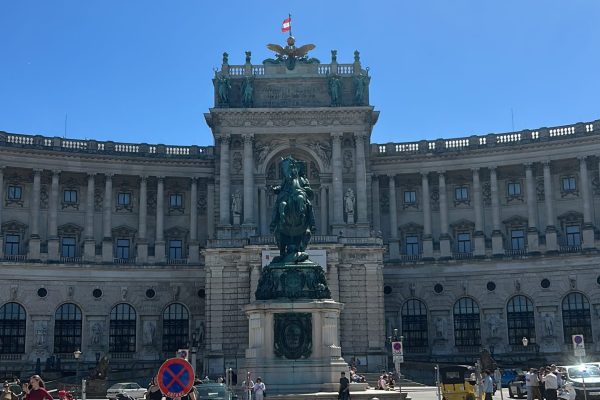
The Hofburg is where the Habsburg emperors used to live, and the oldest part of the complex contains the Imperial Treasury. Entry is €12 for a student who buys a ticket online (more in person), with an audio guide costing €5 and this can be bought in person even if you’ve bought a ticket online. The treasury contains a variety of items, from art and armour to jewellery and coronation robes. If this is your thing, it’s a nice place to visit, and the audio guide is definitely useful as it gives a lot more information about the items than the placards.
Free walking tour
There are a lot of companies that offer a free walking tour around Vienna. Just a quick note – when it says free, the tours are pay what you can/what you think the tour was worth, usually around €10-20 a person (still cheaper than other tours). I did an evening tour that lasted 2 hours and it was a brilliant way of finding out more about the city, especially the Hofburg as the complex doesn’t have many information signs around telling you what the different parts are.
Opera House tour
This is a must if you love opera or ballet. The tour costs €9 for a student and they are offered in English, German, Spanish, and French. The tour lasts around 40-50 minutes and you get to see all the parts of the opera house open to the public, including sitting in the box that used to be reserved for the emperor! Again this is something that should be booked in advance as there are only a limited number of tours a day due to rehearsals on the stage.
The House of Austrian History
This is a small museum located in the Neue Burg, one of the buildings in the Hofburg. Tickets cost €7.50. The museum covers recent Austrian history from 1918 to the present day. I really enjoyed it but I would say it’s more for the history lovers as the Wien Museum exhibition also covers this period, although not in as much detail.
Wien Museum
This museum is next to St Charles Church and the main exhibition is free. It spreads across three floors and gives you a complete history of Vienna. It’s one of my highlights and I would highly recommend it, even for people who aren’t huge fans of history. The terrace of the cafe also has a good view of St Charles Church and parts of the Ringstrasse and Hofburg.
Jewish Museum
The museum is spread across two sites, with a joint ticket costing €11. One site is in the city centre and one is at Judenplatz, which also has a Holocaust memorial. The exhibitions focus on Jewish life in Vienna, past and present. It’s not a huge museum, but I found it really interesting and more thought-provoking than some of the others. If you’re into history, I’d recommend visiting both sites, especially Judenplatz.
Vienna is known for one food in particular – the Wiener schnitzel. It’s so good and a lot of restaurants across the city offer it, but I would recommend looking on menus online to compare the prices as there’s a big range in what they charge. I ate at Schnitzelwirt, which is a bit further out from the centre and only takes cash, but it was worth it – delicious and cheap! I also enjoyed Le Burger, a nice restaurant near the centre that’s pretty cheap for the portions they serve. If you’re looking for something cheaper or can’t decide where to go, have a wander in the Naschmarkt with lots of different foods from around the world.
Vienna is also famous for its coffeehouses but they vary drastically in price. As a general rule, the ones with lines outside tend to be the more expensive touristy ones people have seen on Instagram. If you’re looking for a sweet treat, Aida (right next to St Stephen’s Cathedral) offers ice cream flavours inspired by Austrian desserts like sacher torte. As a well-known dessert invented in Vienna, slices can cost over €8, but an ice cream cone is €3.50 and you get the added bonus of eating it right by the cathedral.
I’m not denying that Vienna can be an expensive city, but there are some things you can do to make your stay cheaper. Forget booking a hop-on hop-off bus. Use the public transport, especially the Ringstrasse tram route. As I’ve already said, the Wien Museum terrace is a nice alternative to the St Charles Church one. If you’re desperate to see the Lipizzaner horses but don’t want to pay to watch a show or morning training then you can see the stables across the road from the Spanish Riding School where you’ll be able to look through the windows at the horses in their stalls. A free tourist attraction is the Ankeruhr clock, which has a show at 12 every day. The clock plays music and some figures move in front of it (it’s definitely better than what I’m describing).
In the Hofburg, there’s a photobooth that can provide you with a cheap souvenir. It’s located in the passageway between the Neue Burg and the Imperial Apartments and it’s also visible on Apple Maps. Taking a photo and getting it digitally is free, but the printed strips cost €5. For food, you can’t go wrong with a sausage hut. They’re all over the city and are a Viennese institution, with some huts specialising in different sausages or spicier food. The one by the opera house even sells champagne.
Finally, my top tips to ensure you get the most out of your time in Vienna. Download the Wien Mobil app and set up an account as you can get cheaper tickets for the public transport system than buying on machines, plus it’s just more convenient. Public transport is €3 a journey or €9.70 for 24 hours on the app. The centre is really walkable so I would advise walking where you can to save money. Bring your student ID! Some tourist attractions will do student prices so you can save a little bit of money. Speaking of money, it’s definitely handy to bring some euros with you as places don’t always advertise online if they’re cash-only. Don’t be like the person in front of me in the cathedral, who asked the worker if they took US dollars despite the signs everywhere saying that they only accepted euros.
When you’re planning, also check what days places are open as museums will often have a day when they’re closed. If you’re planning on visiting any churches or cathedrals, also check when the Mass times are. They normally won’t let anyone in during that hour so the line afterwards can get really busy, and if you go just before Mass starts then you won’t be able to walk around once it starts.
And most importantly…enjoy it! Vienna’s a great city, even on a student budget.
For more travel guides, please click here: https://www.liverpoolguildstudentmedia.co.uk/category/lifestyle/