6th November 2023

Listen
Listen
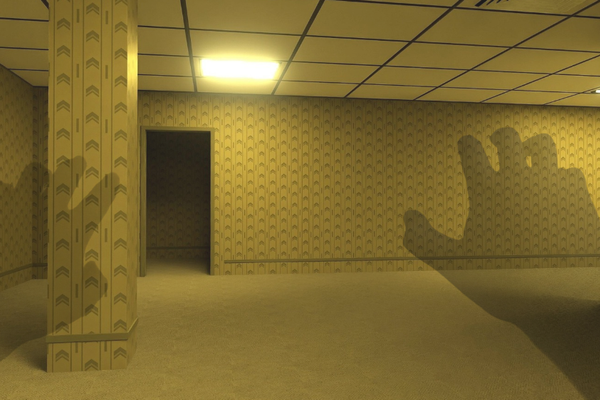
Plotless, liminal, and Lynchian, the ‘Backrooms’ refers to an urban legend borne of locations suspended in time and space, typically taking form as a plexus of empty rooms in a speculative back alley of reality. Someone might walk into the crypt of a church, a yellow-lit bathroom or an empty office and liken the setting to that of the Backrooms. I know that as a child, I was always curious as to where the wafting double doors at the back of Tesco led…
Plenty will know the Backrooms from its portrayal on the big screen as of May 2026. Others have been invested in its development through exposure to online videos, creepy pastas, music, and games. It was an online comment that first marked the conception of the Backrooms in 2019, and under the dedicated sceptre of conspiratorial online forums, it ballooned into the recognisable landscape inspiring paranoic curiosity that it is today. Noteworthy among its contributors is Kane Parsons, whose YouTube series and feature film Backrooms (A24, 2026) have brought new interpretative layers to the phenomenon (spoilers ahead!).
Like the scientists in the Backrooms film, many have attempted to uncover meaning in the Backrooms, and developing theories continue to inspire new fans. Despite this, absolute truth remains elusive, and this is the Backrooms’ greatest intrigue.
Between fluorescent lights and blank walls, images of the Backrooms can seem hazy and nostalgic. The old carpet, beige staleness, and soft hum of the lights may remind us of a grandparent’s home, lathered in staticky warmth and a childlike calm. Fan-made ‘levels‘ are often situated in public spaces like leisure centres, airport terminals, multi-storey carparks, old shopping centres and waiting rooms, which have roused nostalgia for places lost in memory. The decaying past is both uncanny and alluring, its unvisited corners strangely familiar.
By listening to The Caretaker, you probably realise that these paradoxical feelings are also exuded by music associated with the Backrooms, where longing bleeds into survivalist trepidation. You wish both to continue and to stop listening. The film soundtrack, inspired albums and other ambient approaches (like music by The Caretaker and Akira Yamaoka) are amnesic and prickling as the images themselves.
Entertainment Weekly has suggested that the Backrooms film may represent precisely this entangling safety of memory, where Clark, the furniture shop owner, terms the Backrooms ‘beautiful,’ favouring them above his real (down-spiralling) life. A24 subverts the standard run-hide-escape horror that audiences expect into a subtler self-entrapment, where memory becomes a distortive measure, gently shifting the fabric of reality.
Daringly, Entertainment Weekly expand upon this interpretation by arguing that the Backrooms could represent the swallowing redundance of AI tools, which generate infinitely by regurgitating from a limited pool of past and present information. The Backrooms’ rehashed architecture, roly-poly layouts and (in the film) garbled, caricatured entities, all seem to align with this idea. The Backrooms inexpertly warp that which already exists, suggesting that the longer we spend there, the more it feels like our world, keeping the returning threshold undiscoverable. This makes the Backrooms feel mild, only half-dangerous — harmless as the darkness beneath a ball pit…

This algorithmic accumulation of rooms and corridors is not unlike the infinite stream of videos on TikTok and Instagram that many of us find comfort in, either. Through the continued scroll we seek some inscrutable more, meandering on for hours as though inside an extra, reminiscent dimension, all to say that our lulled fascination with the familiar can become morbid and imperilling. Exploring the Backrooms feels productive – with every turn leading you into another room, closer to an exit — and yet an hour later, you might just as easily find you’ve lapped yourself. Memory of the past distracts from reality in much the same way.
It seems apt to suggest that the Backrooms symbolise some form of multi-media-made subconscious given the concept’s community-led authorship, standing in itself as a testament to the power of the mind: how elaborate fear and harrowing narratives can extrapolate from mere images. It is both familiar and foreign, a man-made location stripped of sense. The Backrooms film is admirable particularly for its nauseating unresolve, the way it encourages continued interpretation because, just as the mind resists classification, the Backrooms resist full understanding, no matter how often we send down scientists in hazmat suits to probe at its corridors for meaning. Here, the liminality evolves from structural simplicity to psychic incomprehensibility, reflecting the inherent and absurd mysticism of the hidden chambers inside, and connecting, every human mind.
Some fan-made ‘levels’ have transcended the walled confinement of the original image into dreamscapes like expansive wheatfields. Levels interconnect and vary in survival difficulty, being populated by ‘entities’, and hence we see the Backrooms expanding with our own input: imagine an entity, and it might be around the next corner. Ironic, really, that more conventional monsters have been placed in the Backrooms by fans who couldn’t otherwise stand the empty vastitude, or a mind gone quiet.
This cobbling-together of ideas once again parallels modern social media, where creators pollute the digital void with content, responding to and interacting with each other, building upon our reality. The For You Page is overwhelming and unsortable, formed of videos stringing themselves together, with the phone they’re on functioning as a door opening to the outside, to somebody else’s room, to a new “hot take” but never to an answer, an exit or a conclusion, reflecting an illusive obsession with progress.

The Backrooms themselves contribute to the horror genre by expanding (inadvertently or not) upon pre-existing ideas. The short novel The Yellow Wallpaper by Charlotte Gilman comes to mind, where a labelled-hysterical woman is locked in a room of yellow wallpaper by her husband. Forbidden the stimulation of books and writing materials, she attempts to impel meaning into the wallpaper and escapes by ripping through it, after envisioning another woman – perhaps herself – writhing behind it.
Interpreting the Backrooms in this light may suggest that a locus of concentration amid the saturated, unquestioned repetition of modern life, and our febrile search for meaning in it, may serve as a kind of escape in its own right. There is no end, no escape, unless one consciously conceives it: draws for himself the door, or rips down of her own volition the wallpaper. As much as the subconscious mind is a labyrinth, home to the repressed likes of the Minotaur, consciousness can remain a wieldy compass in the creation of meaning. Clark’s tragedy, in the Backrooms film, is that he becomes too enthralled by subconscious, impotent living.
Comparably, in The Shining by Stephen King, spending too long in the Overlook Hotel prepones Jack Torrance to lunacy. But, it can also be suggested that this liminal space only lets germinate what was already within him; the spectres that haunt Jack could be described as infective projections of his own internal disharmony, self-prescribed visions intensifying to the extent that they become visible to others (like Danny).
In the Backrooms film, Clark finds remnants of his outside life – the furniture shop – occupying the otherwise empty rooms, as though placed there in real time by his own psyche. The main entity present in the Backrooms film is Captain Clark, or Pirate Clark, who seems to be a demoniac version of civilian Clark, a shadow of his disarrayed mind. The entity is Clark’s “lesser qualities” embodied, rage and dissatisfaction materialised as an indestructible, autonomous force, much more obvious to others in the Backrooms than in outside reality.
In a sense, then, the anechoic chamber of the Backrooms stands to remind us that we are at least partial architects of our own reality, and those breadcrumbs that we follow are indeed our own… In the supposed “Age of Information,” we are the result of what we choose to consume.
As much as the Backrooms symbolise an accrual of community ideas, still its images evoke an irrefutable sense of displacement, as though the viewer is some sort of sole survivor. Considering this, it is no coincidence that the Backrooms exploded in popularity during 2020 when the outside world fell still. It was easier to imagine a postapocalyptic reality then, with life as we knew it suddenly seeming so obsolete. Much like the Backrooms, life itself can feel absurdly inexplicable, no matter how gravely meaning is sought after within it.
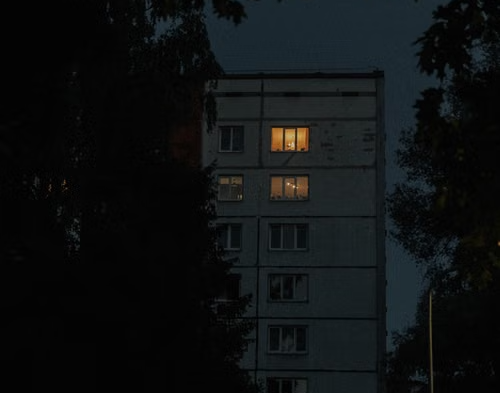
Videos and images set in the Backrooms often take the form of grainy, first-person POV found footage, as though recovered from a lost memory card. Viewers effectively become the fan-made entity The Cameraman – the everyman, the observer, the being responsible for the collection of all images depicting the Backrooms because, by decree of humanity’s ambition, no place should exist without our knowledge.
Often, the walls host arrows and exit signs leading nowhere, implying there avails no escape from our own conscious perspectives. In a place so dead as the Backrooms, awareness of life’s singularity is augmented, making the possibility that you are the only conscious wanderer of this world ever credible…
If solidarity is true of the Backrooms, then its setting may begin to mirror the individual mind rather than a collective one, changing with the personal life of its inhabitant – hence why Clark’s Backrooms are furniture-filled. This logic further suggests that the entities in the Backrooms are of our own making.
Under this notion, however, the general sparsity inside the Backrooms is worrying. If we travel inward, do we truly find nothing but an exoskeleton of urban life? Only a smattering of clues about who we are?
In answer to this, it is interesting that a sense of feeling ‘watched’ arises within the Backrooms, as though the mind presses itself into plainness in anticipatory fear of being perceived. To furnish the mind or write on its walls might feel almost too rebellious, making one’s existence more vulnerable to discovery. Perhaps, then, the Backrooms call us to see office buildings and hotels simply as elemental infrastructures and hollow vessels. Meaning—as in the entities, the objects populating the rooms—is the spawn of introspective excavation, and it is fearsome because it is disorderly and unpredictable (like the pile of furniture in the film), because it rests on our own action and conjecture. The Backrooms plaster a deconstructed and hyperbolic reality before us so that we might recognise the importance of creating ourselves within ourselves.
In the Backrooms, humanity appears untraceable, yet it is still built in expectable boxes and corridors, all fitted with carpets, therefore standing as proof of past life. Even in fully furnished offices, the Backrooms seem plausible – as when everybody goes home and desks sit awaiting return. Perhaps, as these normative spaces are inverted by the Backrooms through desolation, graveyard-silence and exposé, a voice is given to some catastrophic vision of the future, where we are invited to explore the ruins of a postapocalyptic world… lights left chittering on last residues of electricity, shaggy piles of unfinished paperwork, mouses and computer wires all splayed, calendars unflipped.
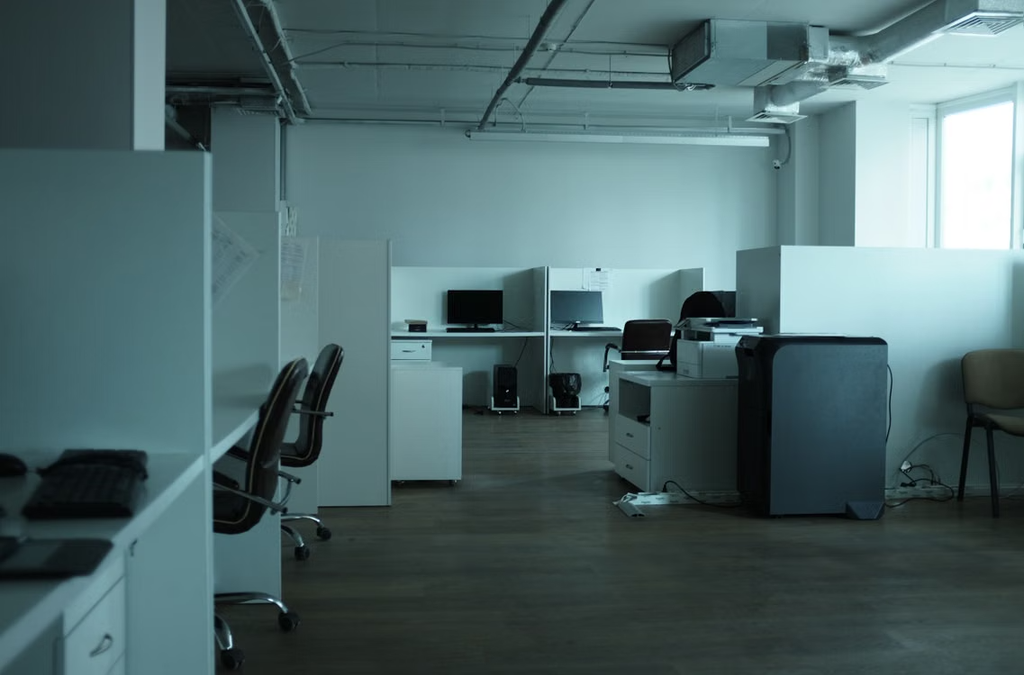
Harking back to The Caretaker’s music as a common accompaniment for Backrooms videos – the sparsity, the jazzy unease, the calm continuum fallible with static – the liminality feels less disturbing than mocking. One can imagine walking around aimlessly whilst this carnivalesque hold music shimmies in the background, and it is from this perspective that a certain frivolity in society’s daily affairs is pointed to. These offices and hotels once so heartily relied on are divested; standing as themselves and lacking command from a fabricated order, they are laughably futile.
Stuck in an inexplicit timeframe then, the Backrooms seem to satirise the eternal changelessness of modern offices, such that they outlast our own kind. The widespread horror inspired by the Backrooms boils down, materially, to fear of a cave system composed of our own urban sprawls and their inherent vagueness.
However, in the face of something so fathomless and immeasurable as the universe (or, the Backrooms…), humans remain miraculous sparks of consciousness, tasked with exploration and the creation of meaning. In its docile horror, the Backrooms might merely mirror the existential dread of this duty back to us.
Many other interpretations of the Backrooms are out there, and many remain to be formed. By drawing upon parts of life existing in plain sight, the concept masterfully turns convention on its head, and its stand-alone freshness is what makes it so disarming. From the Backrooms, we might conclude that liminal horror underpins life like an essential frame, a hidden worldwide cellar, the big blanket of space, and we can choose to ignore it but cannot deny that we do not live in its midst.
Image credits:
Ball Pit Photos, Download The BEST Free Ball Pit Stock Photos & HD Images
Scrolling Photos, Download The BEST Free Scrolling Stock Photos & HD Images
Building with Apartments behind Trees in Evening · Free Stock Photo
Empty Office Photos, Download The BEST Free Empty Office Stock Photos & HD Images
Starry Sky Photos, Download The BEST Free Starry Sky Stock Photos & HD Images
For more arts and culture, please click here: https://www.liverpoolguildstudentmedia.co.uk/category/arts-culture/