6th November 2023

Listen
Listen
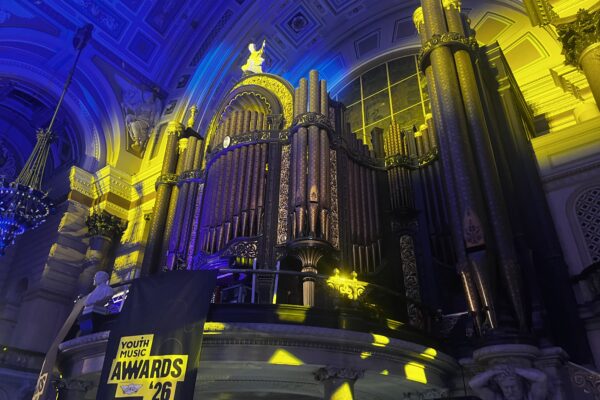
Back in early September, I was contacted by Reuben Hunt of Dawbell Ltd; here, he discussed his new involvement with the Youth Music Awards taking place on October 28th, here in Liverpool at St George’s Hall. From this, we exchanged replies via email in order to collaborate with us here at LGSM.
As someone who’s lived in the North-West all his life, it is so refreshing to see increased Northern representation. So, the opportunity truly appealed to me.
The following list is a timeline for the Awards; feel free to use as a guide for each stage of this celebration:
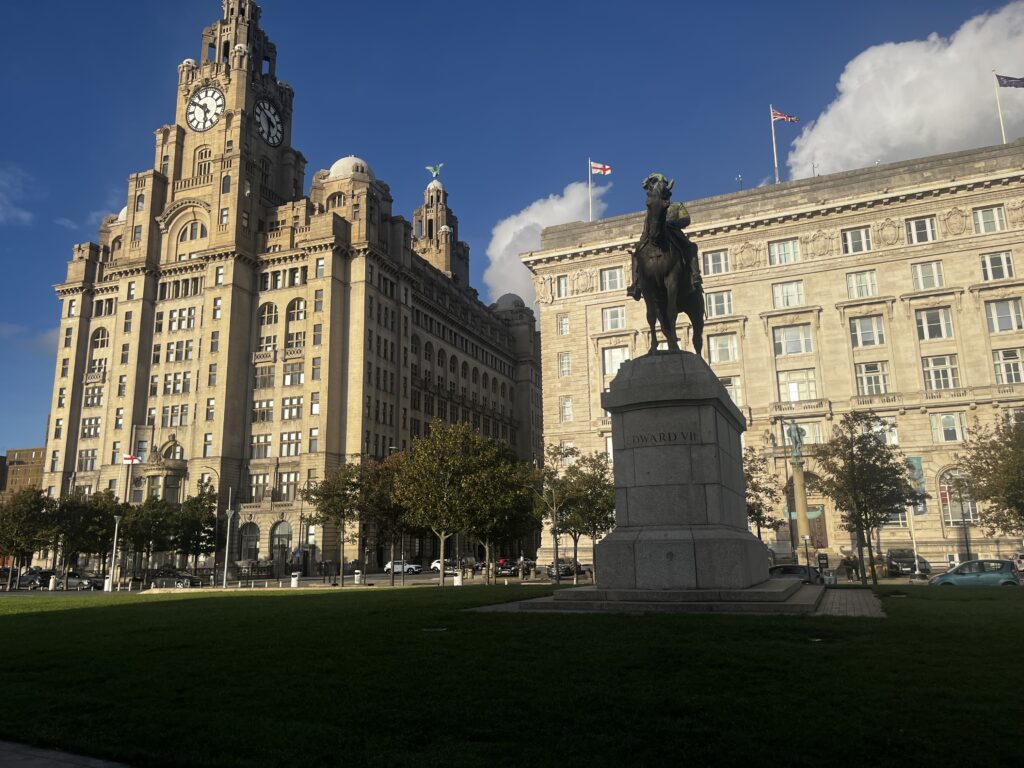
Taking place at the British Music Experience within the Cunard Building on Canada Blvd between 18:00-22:00, the Pre-Awards event was a fascinating preview of what was to come on the 28th of October.
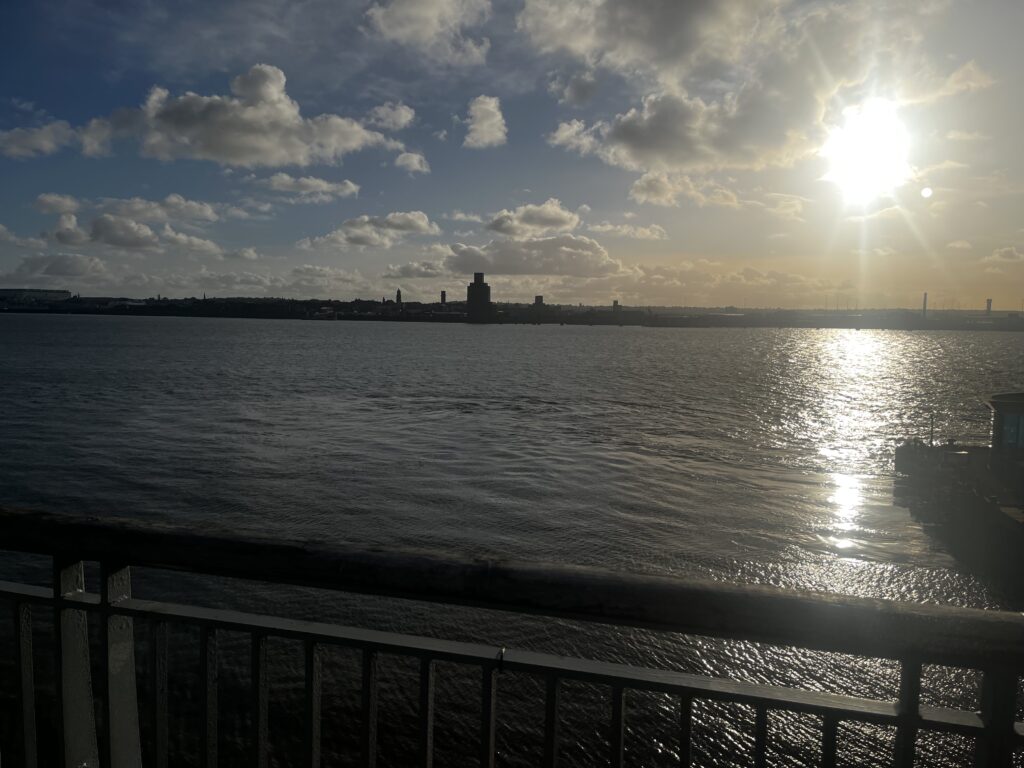
I arrived at the building for 17:30, deciding to pass some time by taking photos of the Albert Docks. When people I spoke to said this was one of the best looking parts of Liverpool, they weren’t kidding:
Once it got closer to time, I got to speak to people also attending the event and finally got to meet Reuben in person. It’s great communicating with someone but you really get to know their sense of character when face-to-face.
If I could sum up the evening, it would be light-hearted professionalism. There wasn’t an air of entitlement or arrogance, but rather capable individuals celebrating the future of music in a city that has helped revolutionise it.
The event started off with a welcome from Youth Music CEO Adam Joolia, recognising that we live in a “time when young people and the wider [music] sector are facing deep structural challenges”. He was incredibly friendly and clearly passionate about what he was talking about, something so important in a climate where authenticity is constantly under suspicion.
Then, taking over for Joolia was BBC presenter and producer Jade Burns – who is also a Liverpool Music Board Member. This transitioned into the next part, which was the panel.
Asking one question: Who Gets To Be From Somewhere?
The aim was to discuss authenticity, place and the music industry’s relationship with regional scenes. This is of course important when noting the shift from London to Liverpool for this year’s Youth Music Awards.
Within this panel featured the following individuals:
Swift addressed that it can often be who you know rather than what you know. Namywa acknowledged how raw talent can still persevere but that sometimes your cultural identity can constrain said talent. Kevin stated that where people come from shapes their music and them as a person, especially those in Liverpool from his experience – he believes that Liverpool artists especially are uninterested in encouraging the games that producers will play.
Kevin stated how it can be because social media gives people a platform but it’s hard if you’re poor to get into a creative career. He and his team try to give people opportunities through schemes. People only get opportunities if others are offering them. Harry remarked how a lot of artists are frustrated with relying on social media promotion; rather, he recommends that artists use Audiofeather, with more info linked here.
Superlative recognised his win from the 2021 Awards, acknowledging the notoriety and significance of such an award. But he also needed support. In the panel, he jokingly remarked how he enjoyed the bragging rights but believes if he was one year younger that perhaps he could’ve received more support from that win.
Harry has been hugely supported by the MYA (Merseyside Youth Association) and be able to get a full-time job. Namywa realised during the COVID pandemic that it was time to experiment and try new things out, especially after the BLM movement. She had to build connections and establish structures that would push her message out there.
From this, she recognises how a lot of funding organisations are going to face the same hurdles as she did. Sometimes, young people have to leave home and ‘chase the pipe dream’, as it were, in hopes of figuring out their music style. Then, they can return comfortably.
Kevin remarked how he would open an authentic, unconventional but diverse record label. He noted that a lot of people were uninformed about other music roles besides being producers/artists/etc. Additionally, he mentioned how many needed focus on developing those skillsets, with the Liverpool City Council having lots of great ideas to further strengthen the music industry with the money they can use.
Overall, it was a lovely panel that had a jovial but firm tone. The panel was capped off with Jade making a callback to the panel’s big overarching question: Who Gets To Be From Somewhere? Well, everyone.
After the panel finished, we were treated to five performances by the nominees; these are the following which performed that night:
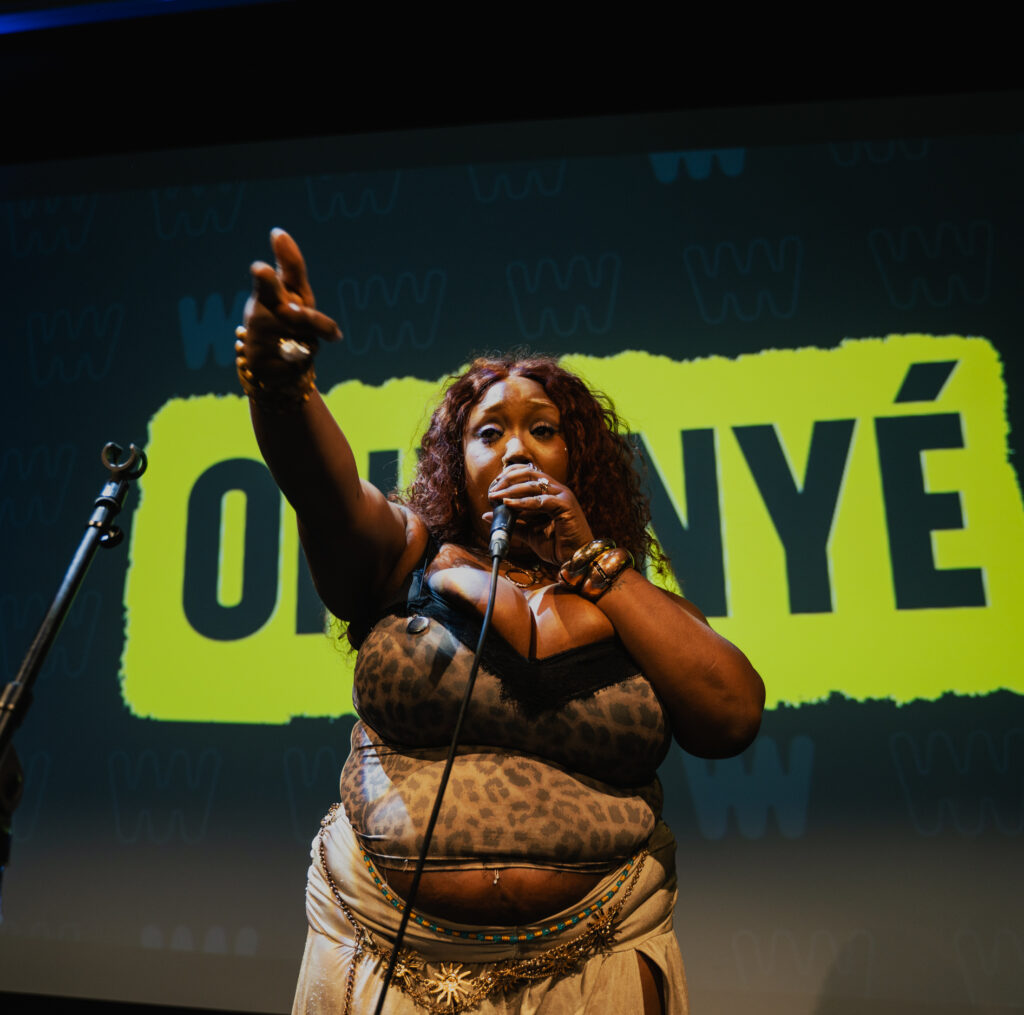
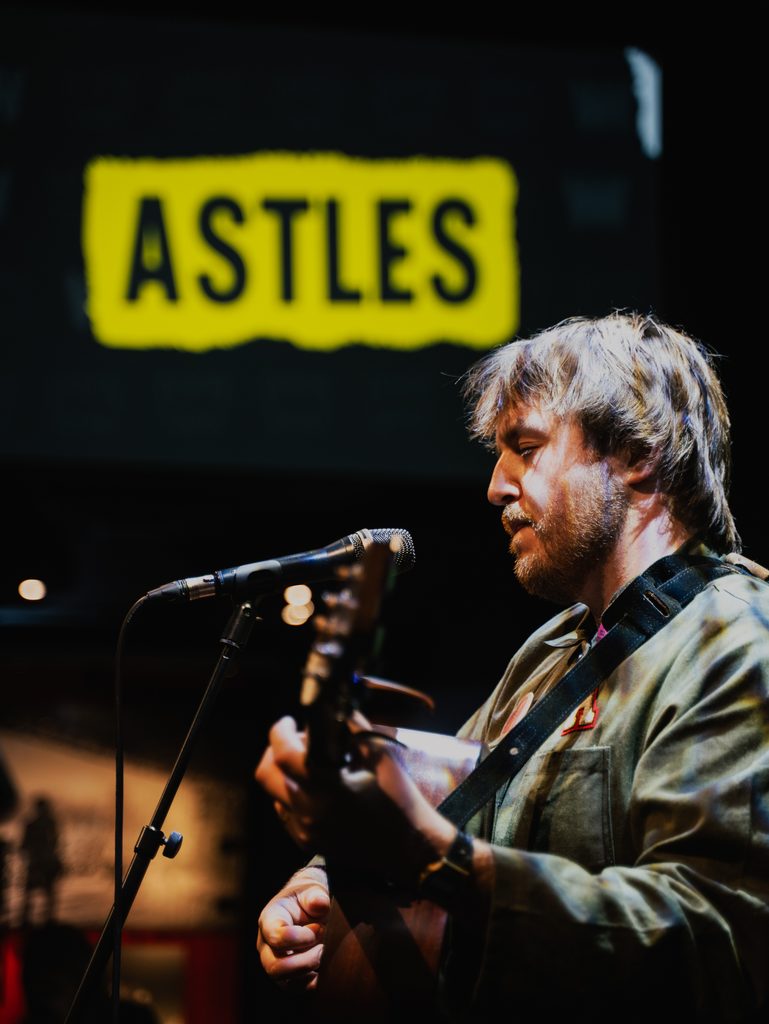
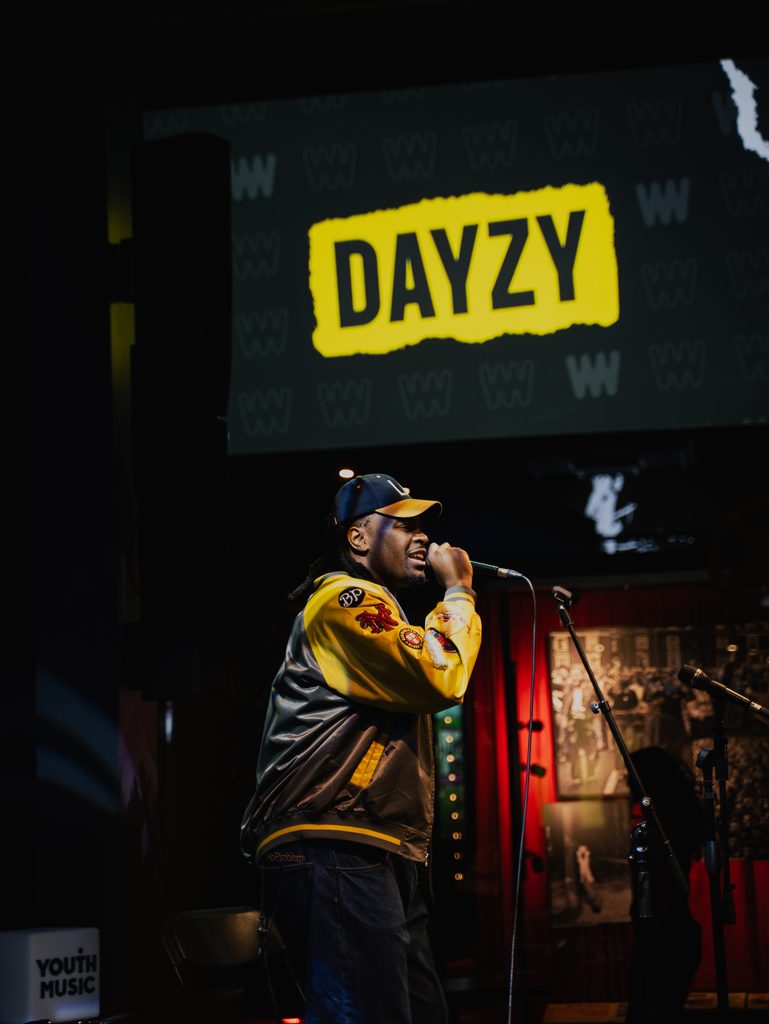
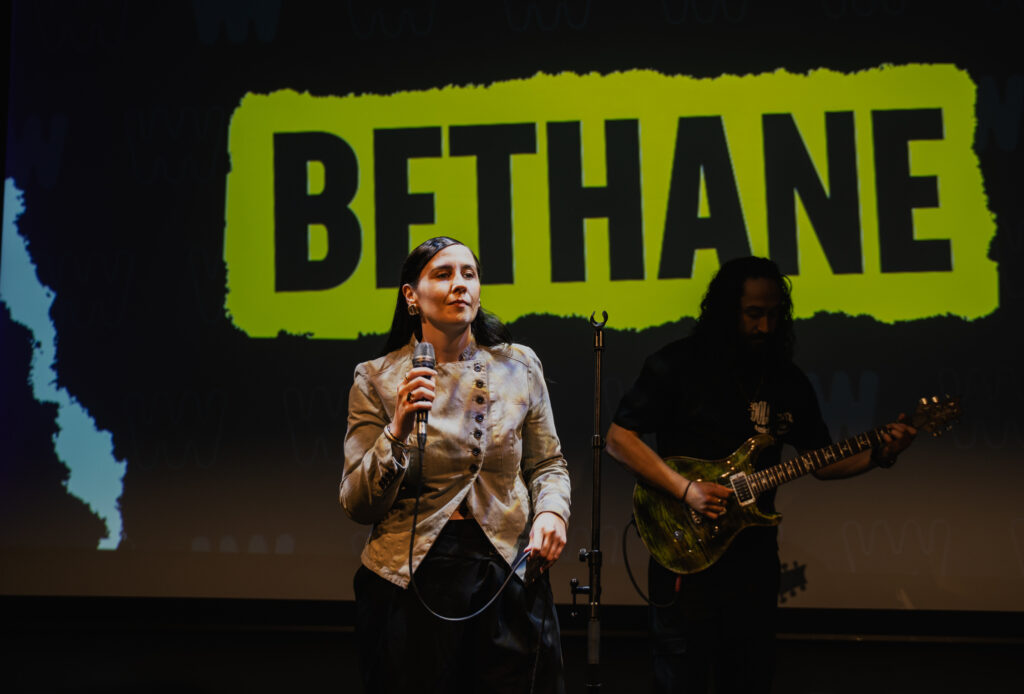
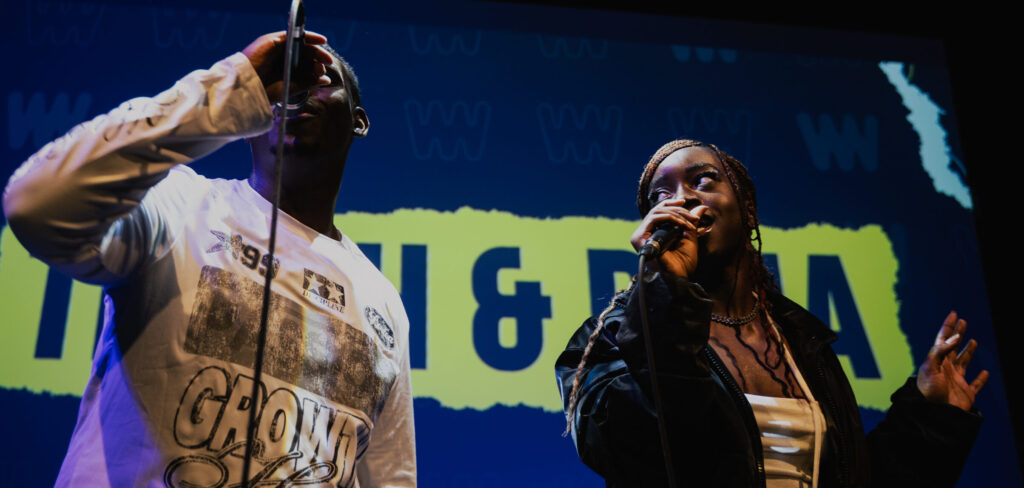
Photo credit: Milly Florintein
Once the performances concluded – which were all fantastic – Jade concluded the gathering with nothing but praise and admiration for both the nominees and everyone who had made this possible. I treated myself to some Wingstop, provided as this year’s event sponsor, which was delicious.
Then, I carried out three interviews, with ONYINYÉ, Astles and Bethane.
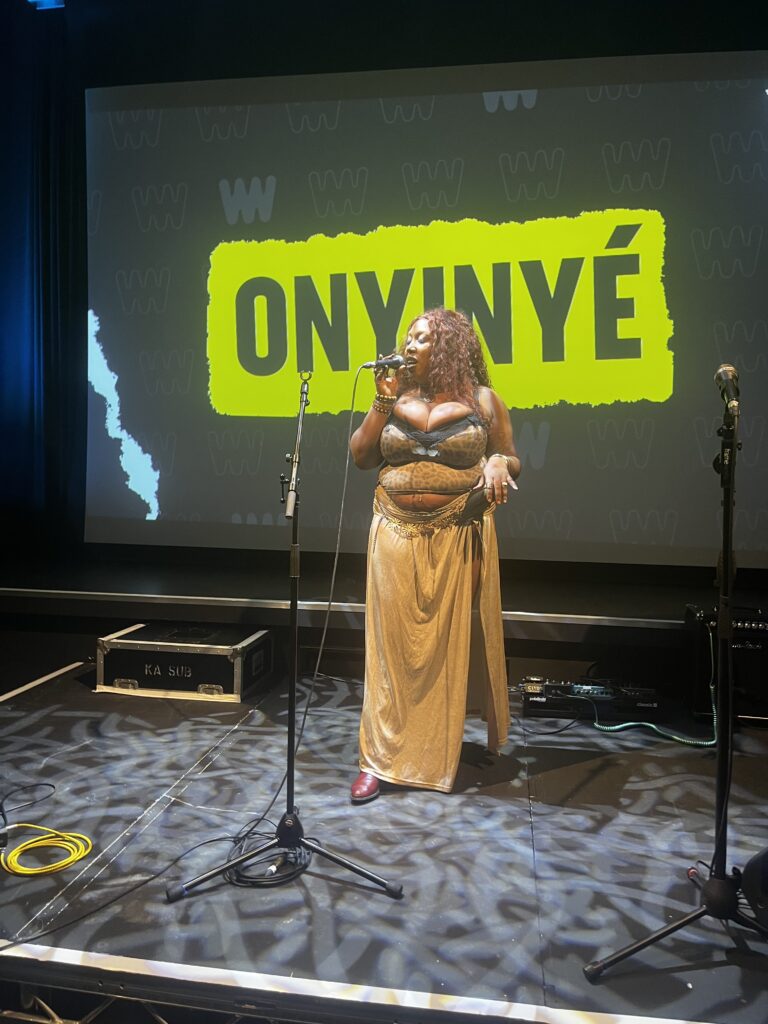
So, who is ONYINYÉ? Well, she is a Black Irish woman. And damn proud of it. This rapper is ambitious and she hopes to be the first ever Black Irish person to win a Grammy this year. Bella’s goal is to create her own genre – pulling aspects from neo-soul/90s hip-hop/jazz/Afrobeats/indie/Motown – and to confront mature themes.
The music primarily concerns love, identity, healing and of course, the chaos and experiences of what it means to be human. But she wants her music to also target young people, helping them on their journeys to adulthood.
For instance, Last Night in Soho‘s lyric around 1:04 of “I thought that you and me together, we would grow old” evokes that theme of love but also grieving what could’ve been; it reflects the unorthodox nature of the human experience.
O – It’s fantastic. I think it’s fun. Let me be serious. I’m about to laugh.
J – SHE THINKS IT’S FUN! LET’S MOVE ON.
O – No, I love it because it’s a relatively new thing. There’s a history of African-American culture, Black British culture, Afro-Caribbean. We’re like new members of the diaspora.
J – When I think of Irish, I don’t think of a-
O – a black person.
J – It doesn’t seem very common. But it’s lovely to see.
O – It is quite common, there’s like 200,000 Black Irish people.
J – Seriously?
O – Yeah, as of 2026.
J – That’s crazy, guys!
O – THAT’S CRAZY STATISTICS!
J – So what is your like, like is your parents like..
O – My parents are Nigerian.
J – So how does it factor into that?
O – So, my mum moved to Italy and then (she lived there for like 500 years)-
J – Just a few years-
O – and then she moved to Ireland and had me there and I was just born and raised there.
J – Whereabouts were you born?
O – It’s called Waterford. It’s South-East.
J – (puts on an Irish accent for genuinely no reason) So I’ve heard of Cork and heard of Dublin.
O – It’s close to Cork. And Cork is the closest place that someone who wasn’t Irish would know.
J – Your accent is so unique, by the way. I listen to it and it has an Irish tinge but it sounds really distinct. I think you should own that accent. That’s yours!
O – Thank you! Yeah, I feel like it’s watering down because I’ve been in England for so long-
J – Yeah, it kind of gets neutered.
O – Yeah! I hate it, I hate it. Because when I go to Ireland, my family, they think I’m British now.
J – Haha yeah, you know [you start saying stuff like] “BOTTEL OF WATUH”.
O – Hahaha, innit, innit. I was like, nooooo…
J – MANTING.
(we proceed to laugh for a solid 15 seconds)
O – Haha, so what was I going to say? About myself? Oh, yes. I’m Black Irish. I started music in church and stuff. My dad was a choir leader at my church so that kind of like, I have a very musical family already as most creators do-
J – Which is good to see though because it encourages you to make more music.
O – Yes, it does, and erm yeah. I just feel like I had a gap where I was like “oh this is a dream I can’t actually pursue it”. And I moved to England and that was the beginning of like, ‘cause I went to uni and was like “ew I hate this. Working, I hate it”. And I think people think that when you don’t wanna work [that] they don’t wanna do anything, they’re lazy. But it’s like this is not the type of life that I want. I want a bigger life, you know.
J – I think I agree with you because a lot of the time, people.. I go uni but I feel like it’s kind of…I come from a working class family, I feel like it’s kind of ingrained into my head to like-
O – Yes!
J – go to uni, get the job.
O – Yes.
J – But there’s so many other opportunities out there. Like my brother wants to get a trade and stuff [as he learns to be an electrician] and I think there’s other choices besides uni-
O – Besides uni. Trades give you money.
J – Exactly! Like I’m being a journalist, and I’m probably not gonna get much money. But I will love the job anyway. That’s why I’m doing that.
O – Aw, I love that.
J – But I feel like, yeah it’s like forcing society to be like “oh you should go to uni, get a proper job, like work in finance. Like NOPE.”
O – For me, my 9-5 is teaching, and I love kids. I love them in a way where I want to influence them with my music. I can do that, bring people together. I can help people understand some of the nuanced experiences I’ve had.
J – That’s what I feel your music is like because I listened to it a few days ago and I noticed you don’t treat the kids like kids. Perhaps you might, but when I listened I thought “you’re getting them ready to be an adult”. I’ve got here about the lyrics concerning your partner who you separated from [in Last Night in Soho] and I think this doesn’t sugarcoat it but lets people know. You said “I thought that you and me together, we would grow old”. And I thought “yes, that is the human experience”. That people need to know about it not being all sunshine and rainbows.
It’s good that you educate people. Young people need to realise and accept that is life and try and find a way out of it. You are a role model.
O – I want to be a role model because these conversations are very adult. I want to have conversations about social injustice.
J – I noticed that in your Spotify bio, it’s something that I resonate with a lot because I think it’s really important. Like, I think musicians, even though a lot people don’t really respect upcoming artists, they respect more the established artist.
O – But like every big change every new era started from music. If you think of the civil rights movements, even like hippies. What do you associate that with in the 70s? It’s the music. We bring forth new generations and new ideas and new things that literally shape the whole [of] society.
J – You’re so inspiring.
O – Oh, stop. My head is like that, it hurts because my head is so big.
O – So, my mum moved to Italy and then (she lived there for like 500 years)-
J – Just a few years-
O – and then she moved to Ireland and had me there and I was just born and raised there.
J – Whereabouts were you born?
O – It’s called Waterford. It’s South-East.
J – (puts on an Irish accent for genuinely no reason) So I’ve heard of Cork and heard of Dublin.
O – It’s close to Cork. And Cork is the closest place that someone who wasn’t Irish would know.
J – Your accent is so unique, by the way. I listen to it and it has an Irish tinge but it sounds really distinct. I think you should own that accent. That’s yours!
O – Thank you! Yeah, I feel like it’s watering down because I’ve been in England for so long-
J – Yeah, it kind of gets neutered.
O – Yeah! I hate it, I hate it. Because when I go to Ireland, my family, they think I’m British now.
J – Haha yeah, you know [you start saying stuff like] “BOTTEL OF WATUH”.
O – Hahaha, innit, innit. I was like, nooooo…
J – MANTING.
(we proceed to laugh for a solid 15 seconds)
O – Haha, so what was I going to say? About myself? Oh, yes. I’m Black Irish. I started music in church and stuff. My dad was a choir leader at my church so that kind of like, I have a very musical family already as most creators do-
J – Which is good to see though because it encourages you to make more music.
O – Yes, it does, and erm yeah. I just feel like I had a gap where I was like “oh this is a dream I can’t actually pursue it”. And I moved to England and that was the beginning of like, ‘cause I went to uni and was like “ew I hate this. Working, I hate it”. And I think people think that when you don’t wanna work [that] they don’t wanna do anything, they’re lazy. But it’s like this is not the type of life that I want. I want a bigger life, you know.
J – I think I agree with you because a lot of the time, people.. I go uni but I feel like it’s kind of…I come from a working class family, I feel like it’s kind of ingrained into my head to like-
O – Yes!
J – go to uni, get the job.
O – Yes.
J – But there’s so many other opportunities out there. Like my brother wants to get a trade and stuff [as he learns to be an electrician] and I think there’s other choices besides uni-
O – Besides uni. Trades give you money.
J – Exactly! Like I’m being a journalist, and I’m probably not gonna get much money. But I will love the job anyway. That’s why I’m doing it.
O – Aw, I love that.
J – But I feel like, yeah it’s like forcing society to be like “oh you should go to uni, get a proper job, like work in finance. NOPE.”
O – For me, my 9-5 is teaching, and I love kids. I love them in a way where I want to influence them with my music. I can do that, bring people together. I can help people understand some of the nuanced experiences I’ve had.
J – That’s what I feel your music is like because I listened to it a few days ago and I noticed you don’t treat the kids like kids. Perhaps you might, but when I listened I thought “you’re getting them ready to be an adult”.
I’ve got here about the lyrics concerning your partner who you separated from [in Last Night in Soho] and I think this doesn’t sugarcoat it but lets people know. You said “I thought that you and me together, we would grow old”. And I thought “yes, that is the human experience”. That people need to know about. It’s not all sunshine and rainbows.
It’s good that you educate people. Young people need to realise and accept that is life and try and find a way out of it. You are a role model.
O – I want to be a role model because these conversations are very adult. I want to have conversations about social injustice.
J – I noticed that in your Spotify bio, it’s something that I resonate with a lot because I think it’s really important. Like, I think musicians, even though a lot people don’t really respect upcoming artists, they respect more the established artist.
O – But like every big change every new era started from music. If you think of the civil rights movements, even like hippies. What do you associate that with in the 70s? It’s the music. We bring forth new generations and new ideas and new things that literally shape the whole [of] society.
J – You’re so inspiring. Your ego is up to here now.
O – Oh, stop. My head is like that, it hurts because my head is so big.
J – Oh, just a couple of narcissists over here. Wait, we’re 6 minutes in??
O – Oh, no. Wait-
J – No, no, this is good. My worry was that this may have been clinical and too formalised. I wanted it to be a conversation. When I saw you on stage, I thought to myself “she is someone I want to get to know”.
(we proceed to laugh and giggle again, because we are very immature)
J – But no, I think it is good to have this discussion because a lot of people may see the persona, you know, that’s how she is on stage. But actually, I’m seeing the layers of who you are and it is great to see.
O – Thank you. That makes me happy, I can’t lie. Because even one of the songs on the album, it’s called Freak Like Me. And it is literally about that because I am very bubbly. And I have big boobs. People are quick to sexualise me and not think I have intellectual capacity.
J – They almost dehumanise you, a little bit?
O – Yes, yes! And then with the music I make. If I perform 5 songs, it’s only those those songs that they’ll use to recognise me and understand my character. But I need you to hear the whole discography, as there’s so much more. And there’s so much more things I want to talk about. And like you said about me being Black Irish. It’s almost like “who knows Black Irish people”.
So, it’s like I am prepared to share this new experience, this new thing. It’s so special. I feel like I had to live through British culture growing up.
J – I’m so sorry about that. I’m sorry on their behalf.
(we proceed to giggle again)
O – Because there was no representation of Black Irish people, obviously. We are the beginning of that. We all started coming in the early 2000s. So, it was true watching CBBC and 4 O’ Clock Club that I was seeing black people on TV and was like “this is me”.
J – The thing is though when I hear that, a lot of people might think to themselves “they’re just saying that because they want to say that”. But when you actually sit down and you see that on telly, it means something to you. It means you’re being shown to the world.
O – Yes, it does mean something! And it doesn’t mean in a way- I feel like the way people describe the feeling, it’s just this like “oh, woke, racial, meh, meh”. But really, it’s very simple seeing someone that looks like you and it feeling normal. Now that I’ve gotten older, I see the significance. When I was younger, I felt it but I didn’t ‘feel’ it. I didn’t understand why.
J – And at that age, you’re so easily persuaded by the things you see.
O – So, they offer grants, Youth Music. They’re so special to me because I didn’t even know something like this existed. Like my friend told me about it, and we both signed up. And he didn’t get it. I GOT IT.
J – Sorry about your friend
O – Sorry, Zacharia.
Disclaimer: I’m rooting for you next year, Zacharia (fingers crossed)
O – And I was just like, oh my gosh. I didn’t even think of how it was going to LITERALLY change my life. When I thought of change, it was kind of like “Tomorrow, I’m getting a Grammy”, you know. It’s changed my life in small ways. In building confidence and being able to create a name for myself. And also [being] accepting of the pace I’m at. It’s just such a beautiful experience.
They offer grants. You do this whole sign up thing. Like, I did a video and they were either “do a video or a presentation”. I did BOTH. I put my presentation IN the video.
J – This is why you’re here.
O – Yeah! Bro, I was like “I have to be different. I need to think outside of the box”-
J – Guys. Let’s shut her down right now.
O – Haha, I was like “imagine if they say you’re doing too much”.
J – “You’re too good for this role, you gotta go home“
O – Haha, oh my days-
J – APPLY NEXT YEAR!
O – Literally! I was shaking. I didn’t even think I was going to get it. Like I didn’t think I wasn’t going to not get it. But I had forgot I had done it. And then the email came through and I was like “What?”. They fund a project and usually people before they sign up for the grant have already planned their project. I had NOT planned my project.
I had listed all the songs I had written, which was so many. And I was like “I need to use some and form a story”.
J – But I imagine if you’ve got so many, it’s overwhelming.
O – Yes! So, I was like “I need to pick some and do something” because a lot of them I had kind of grown past. I wrote them when I was 20, 21. Now I’m like 25, so I was like “what am I going to do with these”. And then I was like “oh, maybe I can make like a story of my life about moving to England”. And so, it just worked out. And even the name and everything, it’s like things I had forgotten about started coming back.
And I was just like “OOH my inspiration is here”. And then yeah, I did a project and then you submit a song to nominate yourself [for]. I submitted a few songs but they weren’t even done. And I was just like “they’re not going to pick me, I haven’t even finished recording these, they’re so bad”. I was just like “why have I even done this, I was stupid, I hate myself”.
(Forced to remove a 30 second long swearing rant, very unprofessional of her in my opinion. Tut, tut)
And they were like “we’re so happy to tell you that you’ve been nominated”. I said, “you can’t tell me like that. You can’t call me. DO A POWERPOINT”-
J – They do a presentation and video back–
O – LITERALLY, literally. There should’ve been one of those things outside my door, like a balloon saying “You’ve been nominated”. Cause I was like “that’s such a big deal”, and it was so casually said. And I was just like “I need to get used to things that I’m excited about or like I want for myself to be normal instead of it being like AHHH”. I was losing my mind, Johnny Wonny.
(I was slightly shocked by someone besides my friends using my persona of Johnny Wonny-)
J – I think it’s hard though when it’s like you don’t even realise what you’re gonna see in the future. At that point, you look at it and you go “Holy sh*t”. You look at that situation and you go “This could be my only chance to do anything”. You need to embrace it with all you’ve got, otherwise there’s not really a passion.
Imagine you just went (says monotone) “Oh, yeah, I’ve won it. That’s great”. I don’t see any passion in that. There’s nothing coming from that which is raw and authentic.
(Conversation after this led to me inflating her ego a lot, so I’ll spare you the transcribed section of this)
J – I have chosen three for you that I think. So, you choose yours and I’ll let you know mine.
O – Top three in what sense?
J – Top three that have inspired you to make your music.
O – Oooh! Stevie Wonder is at the TOP of my list. You know, actually, it’s a clinical issue. I’m actually so worried. I went to see him. First of all, I’ve loved him my whole life. That is my parent’s fault, so I don’t get why they’re now attacking me. I went to see him last year, I was crying.
J – Where did you see him?
O – Hyde Park.
J – How was it? Was it incredible?
O – It was the best day of my life. I don’t think my wedding will top it. I was so close, I got VIP on the day. I’m not standing in the back-
J – Oh, of course. It’s Stevie FRICKING Wonder.
O – I can see him. I was praying, I was like “God I hope he sees” like from his mind’s eye. I was hoping he comes out and touches my hair, the girl with the ginger hair. Hoping he would say “please come on stage and sing”.
J – Oh, gwon Stevie.
O – Oh, I was so happy. So, now he’s coming this year.
J – Is he? Where’s he going?
O – Everywhere. No, this is so bad.
J – Tell me!
O – I’ve just moved house. Money is tight, just gotten back to work. I was ill for a bit.
J – But you’re a famous artist, you’re fine. It’s all a hustle.
O – Period. I’m so happy. So, I had options for tickets for £100. But I said “no, I want to be in the front row”. It’s like £600.
J – Oh my god.
O – And I put it on Klarna. And I called my mum and I was like “I bought these Stevie Wonder tickets” and she was like “you’re so stupid”.
J – Do you need a lift home, by the way? Are you going to be alright getting back? Can you afford to do that?
O – Can I afford to be here right now is what you should be asking.
J – There’s free Wingstop out there, we can get some more.
O – The fridge [at home] is EMPTY. I actually teleported here because I have no money to get home. I blinked and I got here.
J – I can’t, I actually can’t-
O – But yeah, he’s definitely at the top [of my list].
J – Woo. Alright, your other two- gimme your other two.
O – Oh, sh*t. This is so hard.
J – I know it’s hard.
O – Ok, if I’m being honest, Erykah Badu. Because I fell like there is a big influence in my music…This is HARD.
J – I know it’s hard. It’s a horrible question.
O – Yeah, you’re so mean for that.
J – You’re going to find my answers weird actually, now that you’ve told me yours.
O – Doechii. I have to say Doechii.
J – Yes! I hear that in your music slightly, it’s like..
O – The rapping version of me.
J – Yes, yes!
O – Well, I have to say, Bob Marley has to be somewhere there. I can’t leave him out.
J – Of course. A classic.
O – But the top three for real. Erykah Badu-
J – No, no!
O – Noooo!
J – GET IT RIGHT!
O – Stevie Wonder, Erykah Badu, and Doechii. But Fela Kuti and Bob Marley have influenced me very heavily. But I don’t think you can see it in my music yet.
J – I’m waiting to see it, don’t worry.
O – We’re all waiting to see it, don’t worry.
J – Remember me when you go famous?
O – I will remember EVERYONE. You guys are gonna be talking to me and I’ll be like “who are you again?”
J – I get VIP tickets.
O – I’m like “Johnny Wonny…”–
J – Me and Stevie Wonder. “You alright there, Steve?” + (as Stevie) “She saw me live once” + “Don’t you mean twice, mate?”
(we proceed to laugh for a solid 20 seconds)
J – Alright, would you like to know your top 3?
O – Oh, yes. I’m very excited.
J – It is very random. But I feel like your music gives lo-fi vibes, in the best way possible. Like, I listen to it and I go “this is like revision”, but not in a bad way. In like a chill, relaxed “I just got home, and I want to deflate” type of music.
And then I also said Brent Faiyaz.
O – REALLY??
J – Do you not think so?
O – I think in terms of like R&B.
J – There is some slight undertone to Brent Faiyaz.
O – Really?
J – I think so, and I love him.
O – Oh my god.
J – Totally not biased when I put that.
O – Hello! I’ll take that.
J – And then I put, because sometimes I get a bit of a pop vibe to you, I put Mabel.
O – That is crazy that you said that, because I haven’t listened to her since like 2017.
J – Seriously?
O – Yeah! But then, today I started playing my likes playlist on Spotify, and all her music kept playing
J – What’s your favourite song from her?
O – I can’t even remember one song.
J – I know one, because I forget a lot of them. It’s Don’t Call Me Up; “don’t call me up, I’m going out tonight…”. But yeah, that’s my top three.
So, in summary, these are the comparisons between the top three artists chosen:
| My suggestions for her top three | Bella’s top three |
| – Lo-fi vibes – Brent Faiyaz – Mabel | – Stevie Wonder – Erykah Badu – Doechii Honourable mentions: Fela Kuti, Bob Marley |
I managed to peer pressure her into getting a photo with me, to which she reluctantly agreed to get with me. Hoping that Stevie Wonder somehow hears about this.
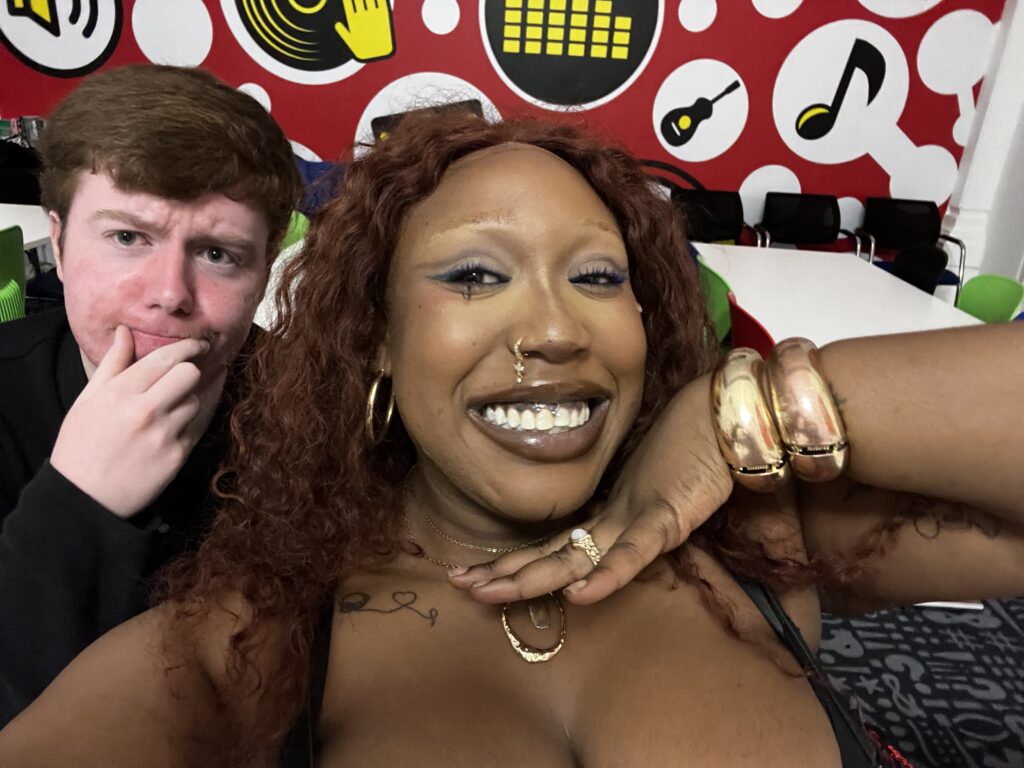
I felt terrible taking her away from eating her food, but she wasn’t mad at all, and genuinely had so much energy to her, it was fantastic.
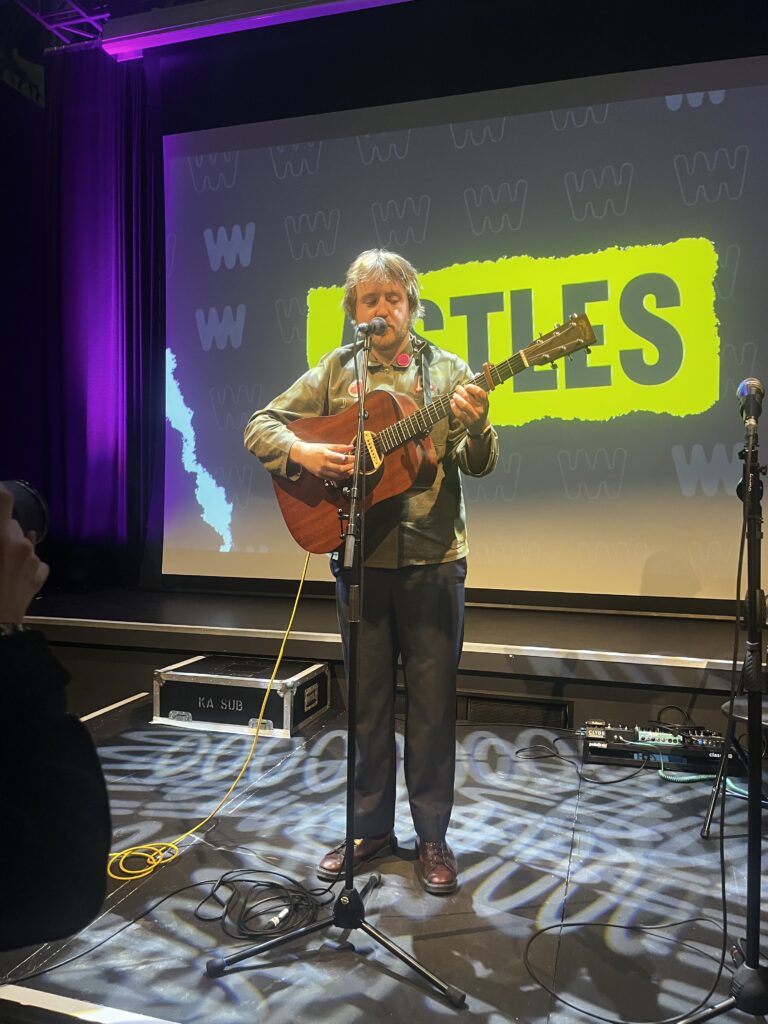
Dan Astles is a Southport-based songwriter, who is a respected member of the Liverpool music scene; his work is honest, reflective and emotionally driven through the stories he wants to tell. For instance, Joe, are you listening is a poignant reaching out to his late uncle Joe. Moreover, his song We Could’ve Been Anything emerged from him finding a mixtape within his uncle’s possessions.
The music draws upon themes of family, memory and place. Throughout it all? He cares about communicating without holding back. To me, I see the work addressing his late uncle linking to the scholar Marianne Hersch and her idea of postmemory (or the ‘memory of memory’). Her term concerns how the generation after victims of trauma respond to the experiences that predate them.
It truly is powerful and evocative.
D – My name is Dan Astles. I’m an artist, performer, songwriter, community musician. I try my best to be a nice guy. And yeah, I just love writing and telling stories and yeah, that’s just who I am.
J – Fantastic. I know you’re respected within the music scene. I don’t live here, as I commute [from Widnes]. But I can feel like when I was stood there, I could feel your impact in the room. You heard it, there was lots of celebrations, a lot of clapping. I heard that, and I thought “Yeah, this guy seems really genuine, because a lot of the time, you see the persona”.
D – Yeah, yeah.
J – But I feel like I’m really getting to see you as a person.
D – Thank you. I try to be quite authentic in that sense. But like, it’s not something that’s contrived or anything like that. It’s just, I’ve always been who I am, for better or for worse. And yeah, I feel very supported in the Liverpool music scene. And yeah, I feel the love as well. So, it’s super nice to be here and be a part of this whole event.
J – I’m excited for the official Awards as well, because I can’t wait to see you all perform. It’s going to be great.
D – Yeah, I know! That’s going to be really fun, yeah. And get dressed up, have a bit of a party.
J – My favourite song of yours, by the way [that] I’ve listened to so far is We Could’ve Been Anything.
D – Oh, nice, thank you.
J – I think when I hear that, I get Conan Gray vibes.
D – Ooh, right. I’ve not listened to them before. What sort of stuff is it?
J – Conan Gray is a male musician who just gives your vibe and music. Also, Alex G. They kind of make [up] your music in my head.
D – Oh, nice. That sounds incredible. I’ll need to listen to them then, that’s so good.
D – Yeah, so someone put me forward for it. And then, yeah, I just got a message saying “you’ve been nominated”. So I was really buzzing. And yeah, as like an independent artist, it means a lot to be recognised in that way. And particularly for the Lyricist Award that I’ve been nominated for, I take my lyrics, like, not seriously is the wrong way, but I take pride in it.
J – Yeah, they’re not throwaway [lines].
D – And they’re all myself and my expression and stuff like that. So yeah, it felt really nice to be recognised in that way. And yeah, I think being a musician, it’s like things like that, like you need stuff to help you keep going because it’s hard work and all that. You’ve got to motivate yourself. So things like that, little pats on the back, little moments of recognition, help you.
If it can give you another six months to keep it on going, then that’s amazing. So yeah, it’s meant a lot to me, for sure.
J – It’s just good that, because I think nowadays, like the big musical artists. It feels almost like the power gets to their heads a little bit.
D – Yeah
J – I feel like the beauty of like a niche, almost underground artist is like, they can build up from the bottom and kind of be authentic through every stage of the process. I feel like meeting people like you and, you know, ONYINYÉ and Bethane and all of you guys.
I think it’s just, it’s great to see that you’re all just being so authentic and so real to the audience. And I think people love that nowadays, especially with AI like making it so hard to judge what’s real and what’s not real. It’s just, it’s good to see music authenticity shine.
D – Yeah, no I agree. I think so, yeah. Maybe to be, I don’t know, successful, you have to sacrifice part of your authentic self. Which is a shame, isn’t it?
J – It is, yeah.
D – But yeah, I think it makes it easier when you’re, yeah, I’d rather be happy and not as successful as some other people being myself. I think the worst thing that could happen is being super successful and you’re not yourself because then it’s just like, where do you go from there?
J – Yeah, definitely. Which is good to see, because like, you know, you should be making it because you want to make it. I don’t think you want to get to a point where you look at it and you go “well, I’m making a lot of money and I sort of care about the lyrics now as I did before”. Where it’s like “oh, well, whatever”.
D – Yeah
J – “I only care about the money now” No one really wants to see that.
D – That’s it, and I think it gets to the point where, you know, you’re paying other people’s way in life and then your decisions don’t become your own.
Like we’ve seen a lot of that with the Ed Sheeran stuff. He clearly isn’t, yeah, he’s not allowed to have his own opinion because he’s so scared of upsetting everyone, which makes him just like nothing, do you know what I mean?
It makes him a proper wet wipe in that sense. So I think that’s really difficult.
J – I can’t believe you called him a wet wipe-
D – Yeah, yeah, that’s it. That’s what he is. He can’t stand up for himself, so that’s it, yeah
J – I saw a post where it’s actually like, not being political is a political stance.
D – Yeah, exactly.
J – Like by choosing to ignore political stuff, you’re choosing a stance.
D – Yeah, that’s it. So it’s, by trying to be nothing, he’s just proved to be something really bad, so yeah.
J – I think it’s how it’s so muddled nowadays, isn’t it? Like you can’t really, it’s hard to figure out who’s on the right or who’s on the wrong, but I think it’s, I don’t know, you just gotta figure [it] out yourself, see what you stand for. Yeah, believe in the right stuff.
Not pull an Ed Sheeran and just get rid of like your, what was it, his performing acts and stuff, like Macklemore was a-
D – Yeah, everyone left him.
J – I think his brother or someone made a statement about it, saying how upset they were. And yeah, it’s mad. It is just a mad situation.
But, no. I was glad to hear about the award. I’m glad that you’re going to be nominated.
D – Thank you.
D – Okay, cool. I’d say the people that have inspired me the most, and I’m seeing this in like different parts of my life. So I would say The Beatles, Frank Ocean. Because when I was, yeah, when I was 16, Frank Ocean was like my favourite of all time. And then more recently, a guy called Andy Shelf.
But I wanna hear your three more importantly.
J – What kind of music does Andy Shauf make?
D – Yeah, he’s like an amazing songwriter. He writes very conceptual storytelling songs and very beautifully stylistically. I’d listen to him like, he’s got an amazing album called The Party, which is like a concept album about a house party.
J – Is that on Spotify?
D – Yeah, on Spotify. Check it out, it’s amazing.
J – I can see that [conceptualisation] though in your music. It’s like, I learnt this in [A-Level] Media Studies, [where] like music has three types: narrative, conceptual and performance.
D – Yeah.
J – Yours is very narrative focused.
D – Yeah.
J – And I think that appeals to me because I’ve always liked narratives and such because I wanted to be a journalist.
D – Yeah, that’s a really interesting way of looking at it. Makes me wanna do a Media course, yeah. Cause it’s like, the narrative is very important to me. And sometimes even I’ll write a song that has no narrative and I’ll feel the need to… To… Almost add one.
Put a narrative to it. Yeah, so that must be how I understand the world in that sense, yeah. So, the media teacher’s right.
Shoutout to Kimberley Wheeler, my old A-Level Media teacher from college
J – Do you wanna know my top three now?
D – Yeah, go on.
J – Okay, so I don’t think you’ll know any of these. I said Wallows.
D – No, no, don’t know Wallows.
J – Do you know Dylan Minnette?
D – No, no, no. This is all new information to me.
J – Well, he performs and he was in 13 Reasons Why. He’s the main guy in Wallows
D – Right, ok.
J – I put Conan Gray, which you also don’t know.
D – Yeah, yeah, yeah. Oh, I know Alex G though. So, one for free.
J – And I did a bonus one: Malcolm Todd.
D – Can I take a picture of these so I can listen to them?
J – Yeah, of course.
D – There we go, I’m gonna check them out.
So, in summary, these are the comparisons between the top three artists chosen:
| My suggestions for his top three | Dan’s top three |
| – Conan Gray – Wallows – Alex G Bonus: Malcolm Todd | – The Beatles – Frank Ocean – Andy Shauf |
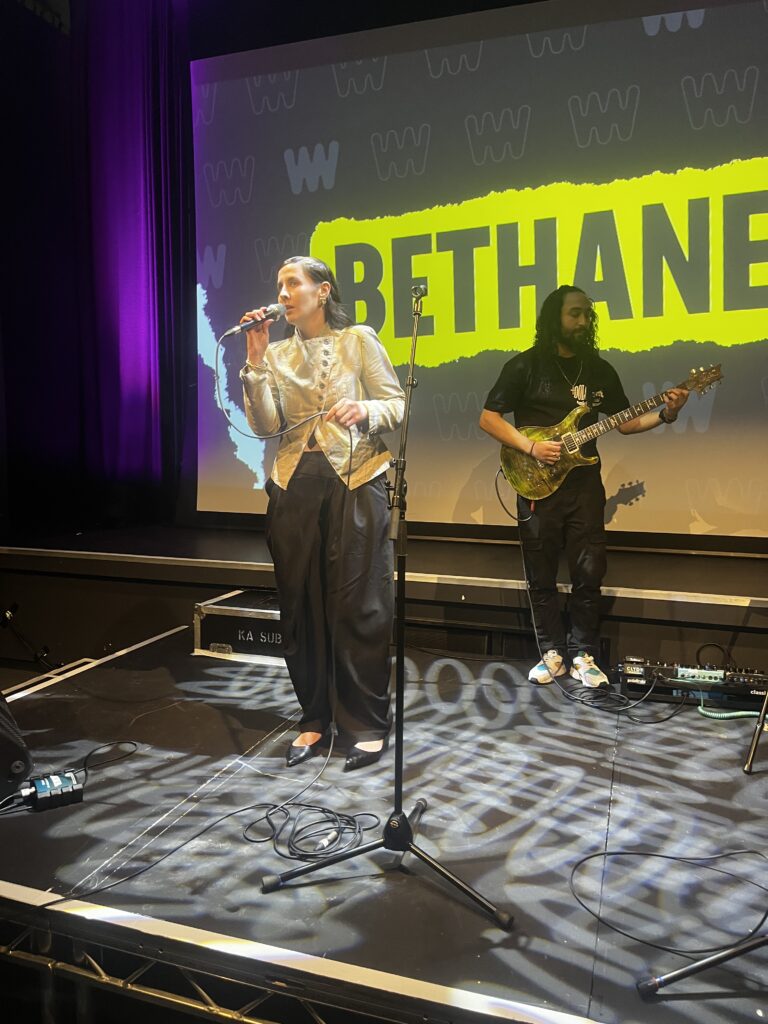
Bethane is a Liverpool-based soul artist, with a fondness for good melodies and amazing vibes. Her sense of voice is one of independence and authenticity, especially with her nominated song Homebird. It explores the double-edged sword of remaining content with your current situation, and trying to exit that place of familiarity. The song depicts being torn between the idea of the self as a fixed label, or a chance to evolve and become anew.
Something I liked which stood out to me on her Instagram was this caption relating to her other song Little Faith on a post back in February – linked here:
“What if the faith you were searching for was yours all along?”
That sentiment rings true in her work.
B – Yeah, so my name’s Bethany with an E.
J – Yeah, I thought, “I don’t want to butcher your name”.
B – No, I know, because everyone thinks it’s like a science chemical. Bethane or something. And like, maybe I should mark it on that and do like a periodic table.
But yeah, I’m Bethane. I’m from Liverpool, as you can tell.
I’ve basically been an artist, I’d say properly since I was like, I think it’s hard to say when you become an artist, because I think like, you don’t make your decision in your mind. And then sometimes you do. But I’d say I’ve knew I’ve wanted to sing and write for as long as I can remember.
Like, I’ve always been that child who was like, made everyone sit down and, and like sing to them and stuff. But I’d say probably I made the decision like when I was like 17, 18. But I was like, this is what I want to do. And I need to just like figure out how to do it and all of that. But yeah.
J – That’s great to see. I feel like when I grew up, there’s a bit of like a stigma, like when people grow up as an artist. I knew this guy in primary school and high school. He wanted to be like a singer. And I felt really bad for him because people were kind of judging him. It’s like, that stigma, people think to themselves, he’s not going to be able to do the next big thing.
People putting themselves down like that isn’t going to help anyone. You should pick people up rather than like, shut down the system.
B – Exactly. Uplift. That’s right, yeah. No, I know, it is all about uplifting.
J – But it’s good that you’re still here making music. Which you’re passionate about.
B – Yeah. No, literally, like I love, I love writing and I love like every side of making music. I love being in the studio. Do you know what I mean?
It’s never like work to me. And like, it’s just obviously we all go through so much in life. And I think like, for me, a big thing- Obviously not to go too deep, but like a big thing for me is like, my brother passed away when he was like 22 and stuff. So for me, it was like, “well, life’s so short”, like I need to, like he told me, “you need to do it”. Like, and I was like, “I will”, because who’s to say we can’t do anything. It doesn’t matter where you’re from.
It doesn’t matter what you go through. You can, you can do it. And there’s ways to do it.
And like, sometimes you’re always looking to the next thing. But sometimes even looking back, like I used to sing behind a wall. I didn’t want anyone to look at me. Do you know what I mean? So like, and then sometimes I have to think of that, like fast forward to tonight, where I do just get up and sing and I love it.
Do you know what I mean? So it’s a journey and it’s a journey for everyone. But it’s like, when you’re obsessed with it, you can’t not. You can’t let it go. You can’t, like, it’s just, no, never.
J – I feel like, as well, as like, as we’re both Northerners, I feel like especially you as a Scouser. I get told sometimes I’m a Scouser, but that’s another story. I feel like there’s a stigma behind being a Scouser. They always just like, assume stereotypes.
Like, “oh you’re a successful Scouser, that’s not really a thing”. It’s like, “no, there’s so much more than that”. Like, I can see you there, but Scousers are so much more than that. And I feel like that stereotype of the North not really doing as well as the South. I think it’s a big part of what this event means to people.
B – No, it is. And that’s why it’s so important. Like, Youth Music coming to Liverpool and it being the first time it’s out of London.
Like, and they’ve chose Liverpool because I think, like, of course, we’ve always had so much history of music, like the Beatles.
So many amazing artists from all genres. And, it’s like, and even today it represents that with like, DAYZY and like Astles and everyone. Like, we were all, we’ve all got our own, like, niche, but we all know each other and support each other.
And I think that’s why it’s a community, it’s such a community to be in. Do you know what I mean?
J – I remember seeing you guys on the steps outside. I can tell there is a camaraderie around you guys, where you like being around one another. Which I think is really hard to see nowadays in the music industry sometimes.
B – Yeah
J – Artists and such will just sometimes do random, controversial stuff.
B – Yeah. And it’s like, we work, we work better when we work together. Like, it’s, it’s always such a thing. Like, we can, if someone’s winning around you, you’re winning, it’s coming around the corner. Do you know what I mean? Because you are what you surround yourself with.
J – Exactly. All right, I made a note about your song Homebird.
B – Yeah
J – I thought about, it explores being comfortable where you are.
B – Yeah
J – And exploring outside your comfort zone.
B – Yeah
J – Tell me a bit more about how you kind of came to think about that.
B – Yeah. So, that, I wrote that at probably one of my first writing camps that I ever went to, which was crazy. And that in itself is, is the example of the song. It’s, I was always used to just writing in the room on my own, even not with the producer there, and then I’d bring the producer in.
So even just the producer being there, and me writing that song there, it was, it was like pushing myself out of what I kind of would normally do. But, yeah, the song means a lot to me. I think it’s, it’s like, it’s being that homebody and being that shyer person, and not necessarily being the one who would walk up to anyone.
Or like, there’s so much to it that you have to do in the music industry, and that comes with, obviously, you can just get on stage and singing. But for me, it’s, it kind of like shows a journey, because it’s like, like in the [song’s] bridge, it’s like, “look at me, look at me rise”. I’m, I’m realising that, “yes, I need to step into it, and it’s me who can do that, and push myself out of my comfort zone, and it is only me who can do that”.
And even though I can still have the comfort and the things that comfort me, but, but like, it’s still having to push yourself beyond that. And, and then also, I think Homebird, like, I’ve always just heard that said around me. Like, that’s such a scouse word, isn’t it? Where it’s like homebird, like, “oh, you’re such a homebird”. And then when I, when I’ve spoken to other people who aren’t from Liverpool, I’m like, they’re like, yeah, they don’t get that.
But like, homebird is like, that’s always been said, “oh, you’re such a homebird”, you, do you know what I mean? But like, and it’s not always said in like a negative way, but like, it could have been, but it was just kind of me re-owning that, but also the scouse term for like homebody.
J – Yeah, yeah
B – Do you know what I mean? Like, cause, cause that, and then also females are called birds, so not that I’d say that, but, but you know what I mean?
J – I think it’s good that like, like in Media [when I studied it], like Beyonce. And she like, she reclaims like certain words that were racist in the past, like the word ‘bama’, that used to be [and still is] like a racist thing, but she kind of reclaimed that.
I see those parallels between your music and hers, it’s like, it’s spoken words but changing their meaning to kind of, make it your own-
B – Yeah, like it’s like, I can, I can, I kind of made it what it is for me and how it was meant. For me and stuff and yeah, and it was just, but yeah, I think it’s a real, it shows like a big journey for me and, and it’s even just musically the song, like in all of my songs, I really love like a big harmony section.
J – Yeah
B – So like having so many harmonies and, and stacking harmonies is such a big part of like my music process. So like in every song now I’m like, “oh, it doesn’t have harmonies”. It’s like, “where’s me stamp”? But yeah, so I loved recording that part of it. We spent like seven hours recording just harmonies.
B – So I basically, I found out. I didn’t know I was put forward at all. Like I never, I never knew at all that like that was a thing, until obviously I got the email from Joe, who works at Merseyside Youth Association, and they’d obviously put me forward. But like, I had no clue. And then I was told that, “oh, you’ve been nominated for Best Original Solo Track”.
J – Yeah
B – I was so shocked, but I was also like made up because I just would never, I just, obviously I wasn’t aware that I was even like put forward in any capacity. Like even just being nominated, like obviously everyone who’s nominated is great. So it’s like, it’s just being in that circle and all of that.
J – It’s just, I can’t, I can’t wait for the awards. I can’t wait to see you all on stage and like get nominated.
B – Obviously, someone’s going to win, but I feel like the taking part is so much, so much more than that, isn’t it? Like you’ve come this far. Embrace it, you know. And it’s just about enjoying the time and like making the connections with the other artists, which we’ve all done tonight.
B – This is hard.
J – I know it’s hard.
B – I mean, I really, obviously I really do love Cleo Sol. There’s so many reasons. I think just like how she presents herself, but not even just that, like how she presents her music. Like it’s so organic and so natural and it just feels like she’s just made, like not the sound wise it sounds amazing, but like she’s just made it in the living room and like it’s so relatable. And just that every element.
J – Very down to earth.
B – Yeah. Like it kind of just like, it’s so nice to just put on in the car if you’re going on a drive or you just need, do you know what I mean? Need that like comfort and soft type music.
J – Something like lo-fi vibes.
B – Yeah. Yeah. No, definitely. I do love Yebba as well.
J – What’s Yebba?
B – Yebba. She’s amazing. I think she’s from America. I don’t know where, but I’ve just seen her live. Like I found a video of hers like 10 years ago. It’s so long. She done The Sofa Sounds in New York and she done a song called My Mind and it’s insane. It’s insane. Like for riffs and everything.
So I watched that and then I seen her like two weeks ago, finally. Yeah. And she done her first show in the whole of Europe in Manchester and I went and it was just, ugh.
J – Where did she play?
B – The New Century Hall. It’s such a nice venue. But like, I finally went and it was just like, you know when you see someone live, you love them more. So that’s probably why she’s.
J – Yeah, you appreciate them more. Yeah.
B – Cause I was like, “her vocals were insane”. And the band. Or the tune. Yeah. Like you hear it on Spotify. Sometimes when you see people live, you’re like, “oh, I didn’t really enjoy that as much”. But sometimes you’re like, “no, I love it even more”. Do you know what I mean? And that was, that was definitely Yebba for me.
J – Yeah. Alrighty, your last one.
B – I’ve got two, but I feel like–
J – You can do two if you want
B – Okay. Thank you. Now, this is a weird one, but I’ve always been, and it’s not controversial, but like, it could be. But like, I do love Drake. I don’t know.
J – Like new Drake or old Drake?
B – Old Drake. Old Drake. Yes. But like, even before that, like his album, Thank Me Later, when he sang, and he was more ‘singer’ then. I think I just hold so many memories to when I like loved music. And I think lyrically as well, there’s so many songs he’s wrote that like no one knows.
Do you know what I mean? So like, yeah, he’s always been kind of a, an influence. But like, definitely like older Drake.
And then, obviously Amy Winehouse. [The] Frank album, that album.
J – You look like her, actually. That’s uncanny.
B – Haha, that’s hilarious. I remember someone I performed and they called me Amy Scouse House. I was like, “are you all right? What are you on about?“. This was years ago. But yeah, so funny. Some drunk man, yeah. Well, well. But yeah, she’s, her album, Frank, literally like, I remember watching her on Hootenanny when I was like eight.
And I was like, “who is this woman”? Like, I just, I was obsessed. And so yeah, that album. Like I just loved her.
J – You ready for your top three?
B – Yes, I’m so interested.
J – Right, so I get slight Clairo vibes.
B – Okay. Yeah, yeah. Like, that’s never been compared, but I actually really like her as an artist. She has R&B tendencies, I think.
J – And then I’ve also got Absolutely, you know, RAYE’s sister?
B – YES! I do really love Absolutely.
J – She was great as the opening act for Renee Rapp.
B – Ooooh, ok, ok. No, she’s boss. What’s that song she brought out?
J – Paracosm?
B – Maybe, it was one on there and it was like, so good, I can’t remember how it’s gone. It’s I Just Don’t Know You Yet. That one
J – Yes! Love that one. And then, this one’s a bit more niche that I kind of know. Her name is Alice Phoebe Lou. She does the song Witches.
B – I don’t know. I’ll have a listen though.
So, in summary, these are the comparisons between the top three artists chosen:
| My suggestions for her top three | Bethane’s top three |
| – Clairo – Absolutely – Alice Phoebe Lou | – Cleo Sol – Yebba – Drake (his older music) Bonus: Amy Winehouse |
3 weeks after the Pre-Awards, I was able to interview two NextGen Creatives – two of several people that help ensure celebrations like these are even remotely possible.
These two individuals were Event Runner Anjali Shelley and PR assistant Evie Johnson – who you may or may not know as this year’s secretary here at LGSM. For more information about our 26/27 committee, check out the Instagram post here.
Anjali is a runner for this year’s Awards, a role she understands by being an event runner with Generator back in 2025, for the Mercury Prize Fringe. She was raised in North London but now resides in Newcastle, getting a chance to experience British culture from both regional perspectives. When it comes to R&B and jazz, she’s the one you go to. But music is something she more so stumbled into – originally studying French – and now finding her way onto the Newcastle music scene.
A lot of emerging talent in the North-East are lucky to be a part of her visual campaigns being created. Here, she is taking on the experience she gathered within creative development when she was working with Nrthrn Baby, a North-East music and culture agency.
Good vibes, a positive mindset, and growing ambition.
You may know her as PR assistant for the Awards. But this year, as mentioned prior, she has become LGSM‘s secretary, with her goal to “Help the society run smoothly, and expand even further than we did last year!”.
Studying Communication and Media in her final year, Evie is someone that has valuable experience within the PR industry, alongside social media, marketing & communication and also A&R (Artists & Repertoire; they act as the bridge between artists and the record company, while scouting for new talent). Originally from Cheltenham, she plans to remain here in Liverpool and make her mark, partly driven by the love she holds for this city.
She works as a freelance music journalist, balancing her workload with telling meaningful stories for that of The Tab, Shindie Magazine and the Indiependent.
Evie: So I’m a current third year [student] at the University of Liverpool, originally from Cheltenham. I’m studying Media and Communications, and I’m hoping to go into music. I’ve been doing a lot, like I’ve done a lot of music journalism on the side. I’m doing an ANR placement this year. I’ve done like a bit of social media stuff, marketing, a bit of everything to just get like a all-round experience.
But yeah, I’m hoping, I’m planning on staying in like Liverpool, up north, because I love it here. So yeah, I feel like I’d love to do something up here, so stuff like this is perfect.
Anjali: I’m originally from London but I’ve been based in Newcastle for the last five years and I’m hoping to stay here for as long as possible.
What am I doing currently? I’m sort of still finding my feet in music. I didn’t do music at uni, I did French and I’m now sort of finding my way in the Newcastle music scene. Which I’ve been quite active in, but I’m now finding my way in sort of like visual production.
So making music videos, visual storytelling, sort of creative direction, any stuff about that. So that’s what I’m up to now.
Evie: I applied through Youth Music. I saw they were advertising for like all their creative roles and I just really loved how they were like, they wanted people like local. They wanted young creatives and like it was just like giving that opportunity. So yeah, I applied through there and then it just went from there.
Anjali: Same. I’d heard of Youth Music before but like not properly, I’m still trying to get to know what’s up in the music industry. So I found out about Youth Music and then I just saw like, yeah, like on their website they were hiring. We did like a little video which was cool just to like introduce ourselves and like what we do.
Me: What was the video about [which] you had to do? Like an introduction about yourself or was it, yeah, just like a little introduction?
Anjali: Yeah, it was an introduction, sort of like your experience and like, yeah, just how you are, I guess.
Evie: So, I’ll be working on the night alongside Dawbell. I’ll be helping run like the live press for the event, like writing press releases in prep. Keeping an eye on everything that’s happening for the event, if like for stuff to report on, taking notes, stuff like that.
Anjali: I’m specifically working on guest management as an event runner because I mean, event runner is such a like vague title. It encompasses so much. So I know that we have like stage management, backstage management, guest liaison, artist liaison.
I’m working on guest liason. I’ll be just sort of guiding people where they need to be, mainly being the steward. But a lot of that entails like, obviously you’re the sort of first point of contact for a lot of guests.
So it’s like really important to like have the best face because you’re representing Youth Music in a way. So yeah, it’s just really exciting managing stakeholders, audience, all that.
Anjali: So, obviously, like I was born and raised in London. And that was obviously known as sort of the city of opportunity, especially for creatives and it was felt like that growing up. So I came to Newcastle when I was 18 for university, and you really do feel that difference. Like even now I have friends sending me job opportunities and I’m like, “it’s in London, I live up here, I want to stay here”.
And I mean, especially being involved in the music scene up here, it is such a small world and everyone really helps each other and everyone’s involved. If you say, “oh I went to this place”, they’re like, “oh I know the person that plays”. And I think in terms of my upbringing and sort of the music scene, it’s been really nice and collaborative up here.
But yeah, it’s definitely very eye-opening to see. I’m sort of seeing organisations and opportunities from the ground up right now. So loads is happening up here. We have the Mercury Prize coming, literally like a week before the Youth Music Awards. But I know the people running it. So it’s quite cool seeing like, “okay, people are like starting things now and building that opportunity“, which is really nice to see.
Evie: So where I grew up, it’s like a small town. It’s like, I’m not gonna lie, there’s nothing really going on there. It’s very much like, say you wanted to go to like a gig or something, you have to get trained somewhere. Like there was never really much opportunity. I always wanted to get involved with like music journalism in like some form.
And I’d literally end up just like, writing blogs, just on my laptop, not to go anywhere. I’d be like, “oh, I want to do this album review”. And I just like, write it on my notes app. It would be very much like that. But then, and Liverpool was always the place I wanted to go for music. My parents went to uni in Liverpool, and they absolutely loved it. So I was like, “yeah, amazing”.
Like, Liverpool is the music city. So I was like, “that’s so ideal for me”. And then like, since moving here, it’s literally been like, such good opportunities. I feel like obviously, that is that like, London, North, like divides, like, you can always tell. Like, I’ll be looking for stuff. And it’s like, “full time London, London, five days”, like, okay. But I feel like there is still like, a thriving music scene in this city, which I definitely love.
And it’s definitely a change from like, where I grew up, where there would just be like, someone in the local pub, where now like, there’s so much here. There’s so many great like, grassroots venues, there’s so many great like, independent magazines. And it’s just like, it’s a really like, good comparison.
Me: Yeah, I feel like I agree with you on the divide, because I think I see it on like, Instagram accounts, sometimes. Like the uolscenes account on Instagram. They mentioned confessions from students of how like, “oh, I hate the northerners, I hate the southerners”.
It’s like, you don’t need to have a division anymore. You know, we’re very much past that. And I think it’s more so about accepting what both sides do good, and what they do bad, and kind of improving on each other’s aspects.
I think with the Awards, that kind of shift from London to Liverpool is kind of going to showcase that hopefully.
Anjali: I mean, like, I’m surprised that it hasn’t happened sooner, to be honest. Like, I love Liverpool. And like, it’s like, like, I feel like culturally, it’s known as one of the biggest cities in music. Like, I mean, like, cliché, but like the Beatles, you know what I mean? Like, even having that. I mean, it’s something I’ve noticed quite recently with a lot of big award shows as well.
Like I said, the Mercury Prize, last year. It was in Newcastle, and it was the first time it was outside of London, just like the [Youth] Music Awards. Now it’s back, and then the BRITs is in Manchester. And I feel like it’s expanding a lot more. And I think that, like, yeah, I’m just surprised it hasn’t happened sooner, because it makes so much sense.
Me: No, I agree. It is frustrating, though, isn’t it? How it’s like, it’s took this long, almost. Like, it is great that it’s happened this year, but it should like a standard at this point, especially after like, how so much of the North has kind of showcased their talents. You think something like this would have happened sooner, but it’s going to take time, isn’t it? It’s going to take a lot of time to kind of see that change happen. And it is [happening], but we’ve just got to be patient.
Evie: I think it’s like, everything’s really in London, like, yeah, in this industry. Historically, or like, just in the last like, 10 years, I feel like everything’s been so London-based. Yeah, like, I feel like when you’re getting, like, I know for myself, like, my parents have said to me, I’m like, “Oh, I want to get into the music industry”. And they’re like, “well, you’re gonna have to move to London, then”. And I’m like, “well, why? Why do I have to do that?”
Like, I feel like it’s just been like, kind of ingrained into the industry that everything has to be so London. And I’m like, I feel like you said, like, I feel like it has to be like, there needs to be a change of that, like, it needs to be more. I’m surprised it hasn’t happened sooner. Where like, yeah, like, I feel like these awards are like the start of it. I feel like there is going to be a burst in the future.
Anjali: Yeah, there’s so many amazing, like, like you said, like so many amazing, like independent blogs and magazines and like labels as well. Like, I think also all the major labels are like in London as well, like their head offices. I think EMI have EMI North. I think they’re like one of the only major labels to have a Northern office. Which is insane. And they’re like fairly new.
Me: And it feels like when you go on like job applications, it’s always like London. Oh, it says remote. That’s great. But it’s still kind of in London. Even if I’m remote, like away in the north, I still have to kind of-
Evie: It’s like London, but you have to commute like a day a week.
Me: Yeah, you’ve got to associate yourself with the Southern like prestige almost, it feels kind of, I don’t know, quite frustrating to see sometimes. But at least the change is coming now. We’ve got to be patient, guys.
Evie: I feel like a lot of the work that I’ve done previously as a journalist, it’s given me like quite a lot of familiarity with how PRs work. So especially for the tab, because I’m an editor for the Tab, I’ve done stuff for, yeah, Shindie [Magazine], I’ve done stuff for Tape magazine. And like with that, I’ve like had to communicate with PR, especially for [Liverpool] Guild Student Media as well.
Like you’ve had to, constantly having these press releases sent in, constantly like communicate with PRs. And I feel like that’s given me a view from both sides, really. But I feel like also working, say like working in PR like now and like working with journalists, I kind of know what journalists want, if that makes sense. I know the best of both worlds really.
Me: Yeah. Cause it feels like I was doing some research and so it’s like a misconception that PR is like positive journalism and it’s more so about kind of what the client wants, which is a bit unfortunate. That’s what they’re being paid to do. Whereas, journalism is about the facts and kind of giving the profile.
Evie: But I feel like there’s quite a lot of crossover as well. I feel like the skills that you gain through journalism, you can use in PR and the skills that you’ve gained through PR, like you can use [for journalism]. I feel like that’s a lot of the same in the music industry. Like there is so much crossover in all of the roles that it’s literally, you do one thing and you’re like experienced in other things.
Anjali: Yeah, for sure. I mean, yeah, I had the amazing chance last year to be part of the Mercury Prize Fringe run by Generator. So I was a volunteer for them. And I feel like it really makes you realise how much goes into an event. Even though I was in programming, I had done some live event promotion and programming before.
And it really makes you think about like how much work and how much communication, how many people are involved, like all the tiny little details that needed to go into a good event. Because I feel like when you’re experiencing an event, when it’s a good event, you don’t think about it. When it’s a bad event, you go, “ooh, could have done something there”.
So when you’re actually sort of running it and like being part of it and being the first point of contact, you realise, “OK, this is what needs to be done. This is the best way to talk to people. This is how to communicate efficiently”. So I’m bringing all of that with me to this role, I think.
Evie: I think first of all, with the location, I think I’m really hoping that the, like we were talking about before, I hope it raises the awareness of like Liverpool as a music city on like a larger scale. Like I’m hoping more people like with the success of this, more people will be like, oh, wow, like there’s these amazing venues, there’s this amazing talent like up North.
Like, why don’t we do this more? Like, why?
Why is there not this more? And I’m thinking and maybe like for the nominees, I’m just hoping like I’m hoping it‘s taking away from this London-centred view, like a lot of the nominees are based in London. And I’m hoping like with this not being in London, with this being up North, with it giving a voice to everyone, really, that young music[al] talent can be like, “oh, I don’t have to make myself London based to get this recognition. I can like I can do other things. I can I can be recognised and not have to travel inside the M25″.
Anjali: I think highlighting Youth Music as an organisation as well. I think it’s really important for the nominees and like us, like the creators, like through the training days, I’ve met so many more creators from different parts of the country that have been so involved.
So I think it’s a really good chance to show that there’s opportunity for not only like musicians, but people who want to work as part of the industry. And like you said, like the fact that it’s moved up to Liverpool, like there is so much scope for it. Like you don’t have to go down to London and you can connect to it. You know what I mean?
Anjali: Yeah, well, right now, I’m like I said, I’m sort of working on sort of like visual production and helping artists. I’m sort of yeah, I like I’m trying to like get a camera and like just figure that out because I really enjoy like visual storytelling. I love music videos.
I’m trying to do more events within music videos and music adjacent, but I’m also currently directing and producing my own music video with a team of like really local creatives that I’ve commissioned for a number of artists up here. That’s what I’m doing right now.
Me: Oh, what’s the music video about? Can we have any details?
Anjali: It’s about sort of the artist being in our home space, in her home. She’s in her safe space. It’s quite simple. It’s more sort of artistic, but it’s sort of her finding her freedom and comfort in a space that she’s made her own, essentially.
Me: That sounds great, I can’t wait to see it.
Evie: I mean, so I said before, I’m in my third year now. So I feel like for me, it’s mainly just working alongside my degree to just gain as much experience as possible. So I’ll be continuing my stuff like in journalism for like Shindie, The Tab, Tapes, etc.
Also, I should be this month or maybe next month, starting my placement at Future Yards doing A&R, which I’m looking forward to. But yeah, I feel like it will just be a case of, until I finish my degree, just balancing everything out, trying to extend my CV, trying to like just get as many opportunities as I can alongside everything.
Me: I think it’s hard when you’re in third year, I imagine. I mean, I’m in second year and I’m already feeling the pressure a little bit. I imagine it’s much worse for you.
Evie: Yeah, it’s like workload and everything alongside trying to do as much as I can.
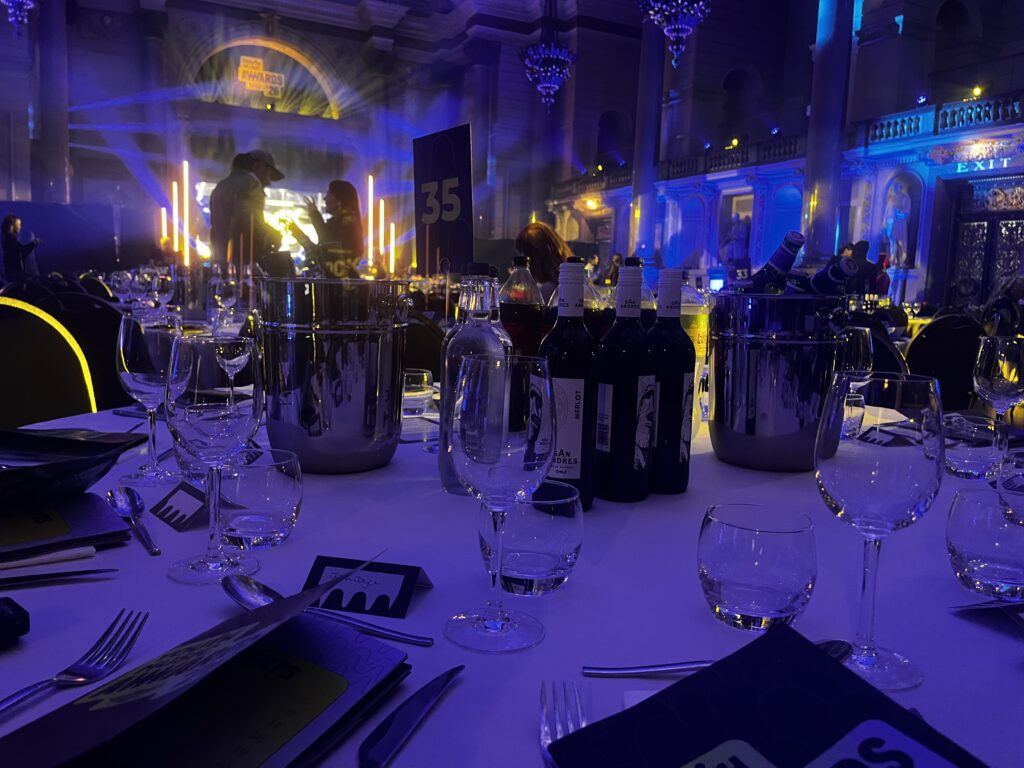
After realising we were at the wrong door and trying to attend an orchestra in fancy attire, me and my friend Isobel made our way towards the steps of St George’s Hall. The red carpet was out, everyone had great fashion sense, and the excitement continued to grow. Making our way inside, we were seated at Table 35 towards the back – which was actually still great because we got to our seats first and the show was still visible.
From this, these are the photos I captured:
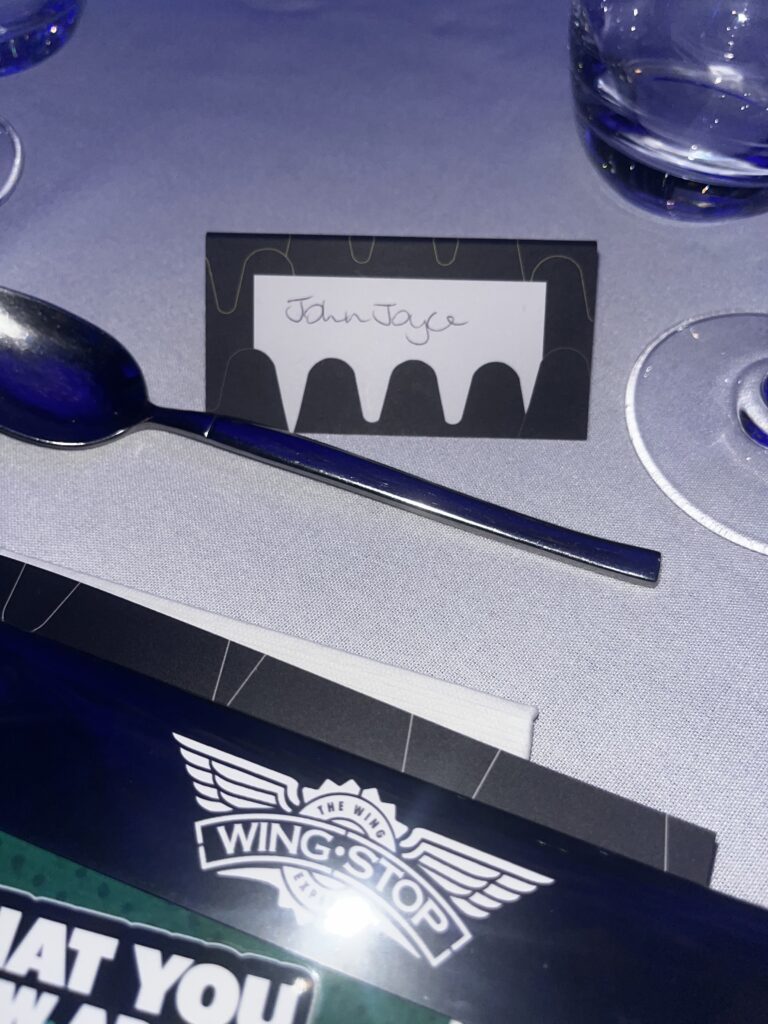
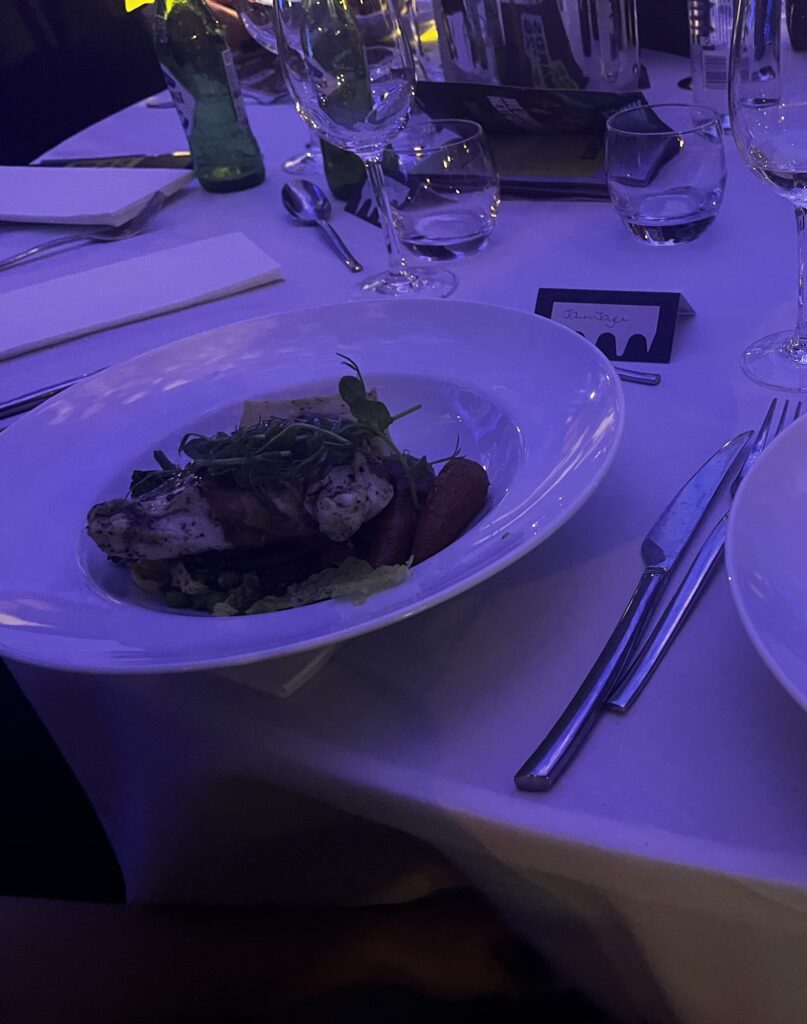
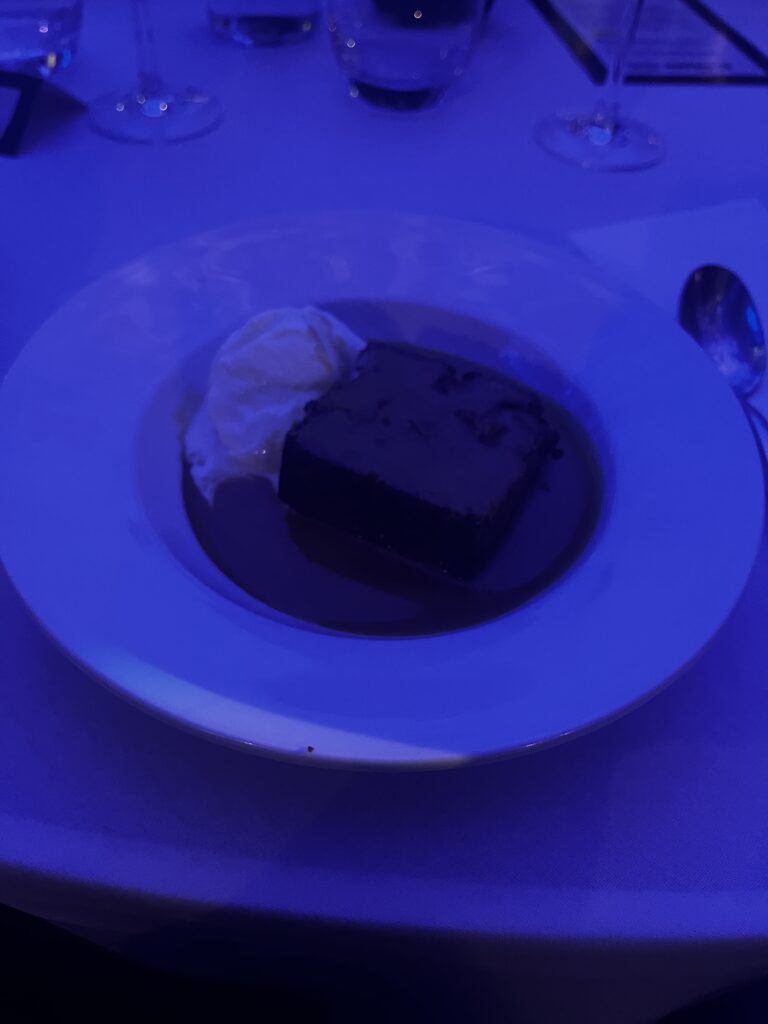
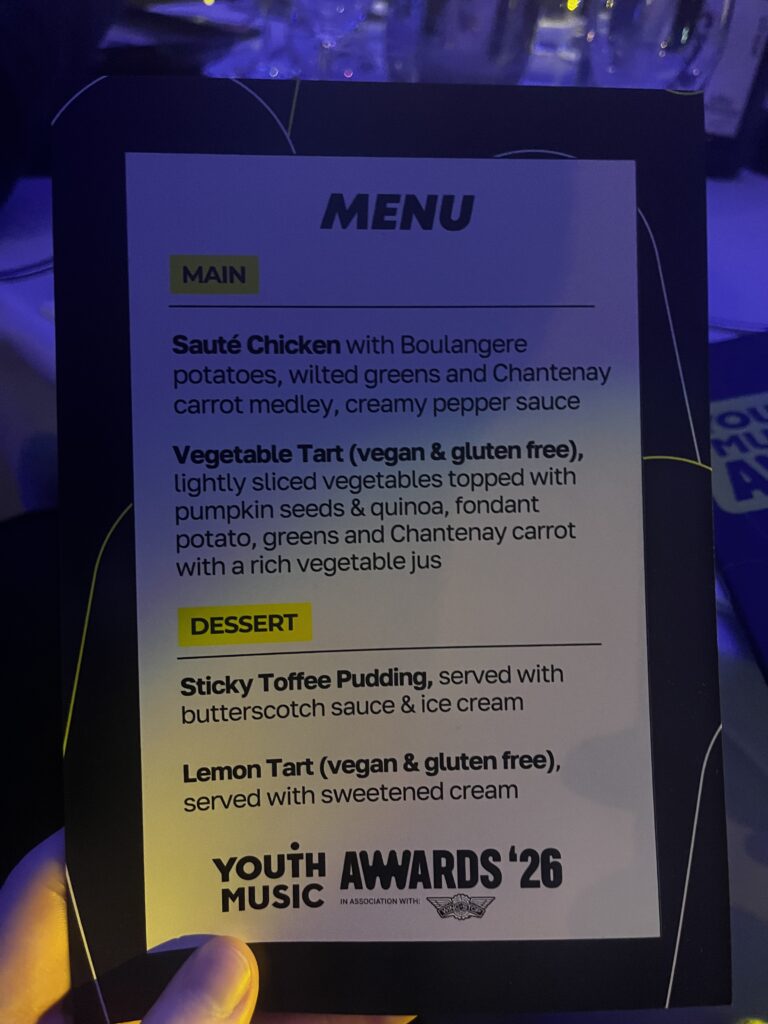
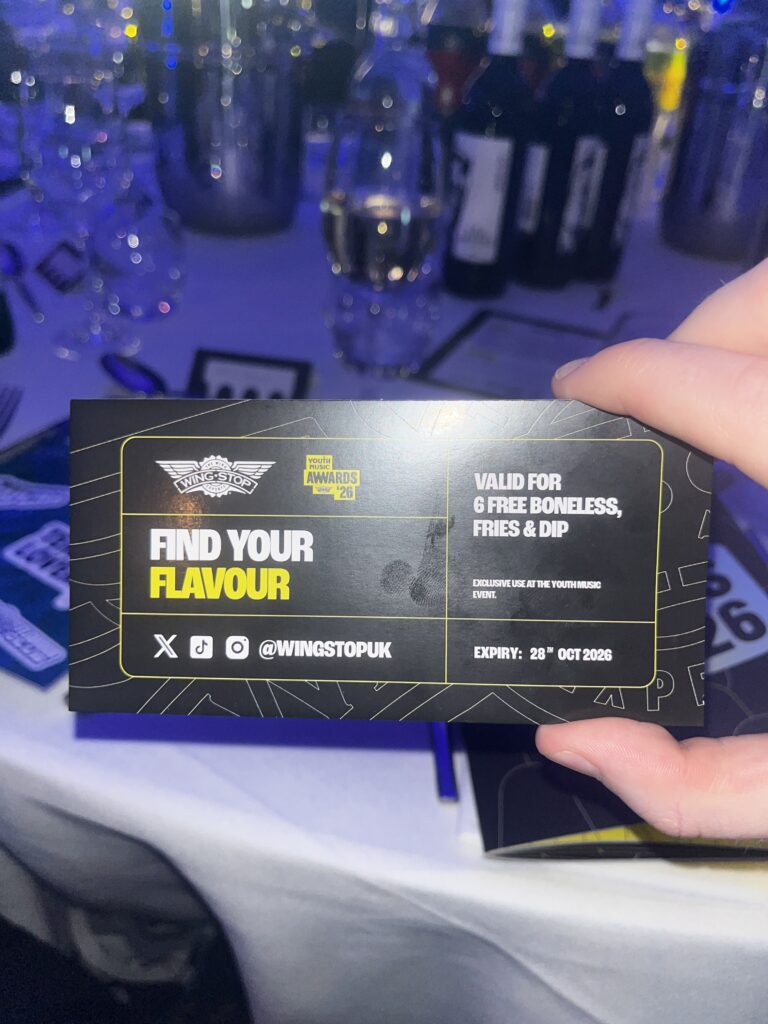
I did immediately message my friends Brooke and Alex after seeing STP was on the menu, since I felt privileged to conduct my own review in honour of STP Guy.
Truly, a special moment in history.
I am a picky eater, but the Sauté chicken and Boulangère potatoes were surprisingly delicious.
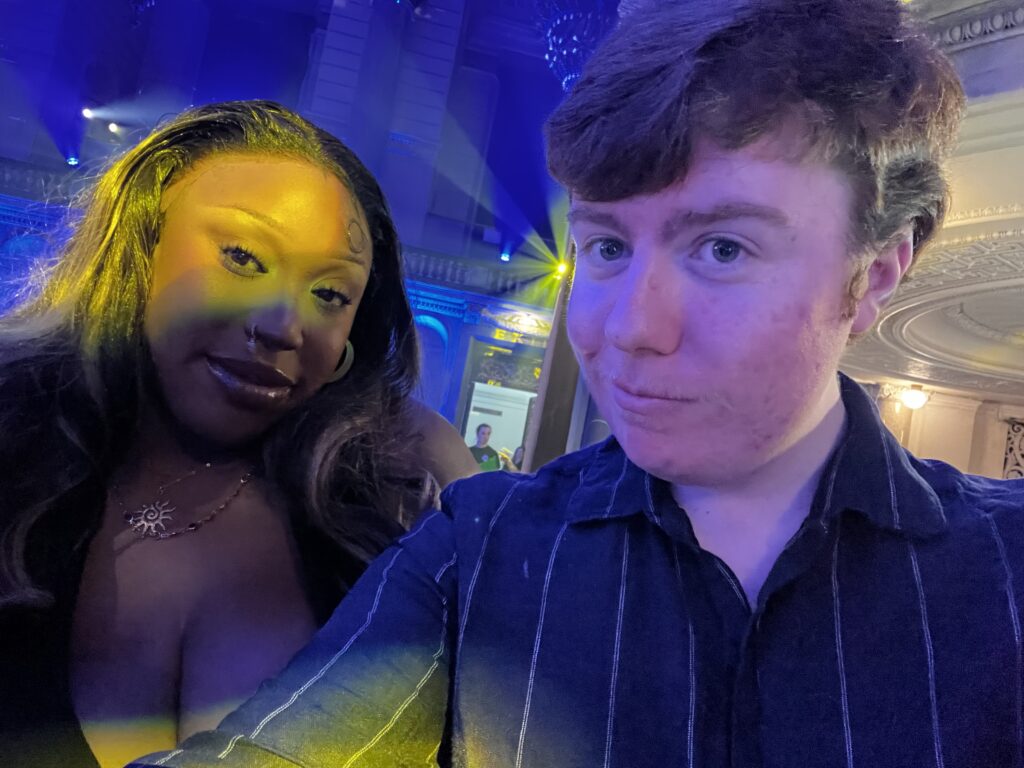
Furthermore, me and Bella had a cheeky reunion, as Isobel had noticed she was being interviewed behind us:
After everyone was seated and dinner had been served, we were introduced to our hosts Crystal Raybe and Success Aryibi. I wasn’t really engaging with their discussions on-stage, as I didn’t find them that entertaining – mainly because it felt scripted. But I appreciated the reinforcement of how significant is to be carrying out the Awards here in Liverpool. And I could tell that they were excited to be up there presenting the event.
Youth Music CEO Adam Joolia had delivered a fantastic speech, saying:
“Grassroots music matters because it creates confidence, community and connection; it doesn’t start in a venue. It starts in a youth centre, in community settings. Together, we need to build an even stronger case for grassroots music…[as it] allows people from all backgrounds to have a chance”
Moreover, he stated to the nominees how “To be shortlisted from hundreds of entries is a huge achievement in of itself”, highlighting the immense work and dedication that they’ve showcased.
As someone who has spent over 20 years supporting grassroots music, Joolia has seen when young people have the conditions to thrive. He used this to transition to Liverpool rapper KOJ’s performance, by praising his work of exploring the “extraordinary potential of young people and how often that potential can go unsupported”.
Here, KOJ used his exclusive track Humble Abode to open up the start of performances, exclusively written and recorded for the Youth Music Awards. Moreover, he also performed live renditions of his tracks A Roadman’s Tale of Home and Punk Panther.
Judged by a panel of over 60 individuals across music, media and technology, the awards highlighted emerging talent and music projects across the UK, which revolved around individual artistic work and industry roles.
Moreover, interspersed with the nominations, some of the nominees carried out their own performances, which were great:
The night was capped off by the return of our hosts Crystal and Success, alongside a speech from Co-Chair Charlotte Edgeworth, thanking everyone for their attendance.
Overall, this last month has been an unforgettable experience. As someone who has had a mixed relationship with Liverpool as I felt choosing to study here was more of a ‘safe’ option by commuting, I’ve grown to appreciate and admire it more and more each day.
In terms of the Awards, I think it’s a bold, necessary step in narrowing the gap between the North and South’s creative visionaries. No matter where you come from, your voice deserves to be heard. Be that in music or otherwise.
Special mention to Reuben once again for reaching out. None of this would be possible on my end without you.
What do you think? Feel free to email me at johnjoyce4535@gmail.com!
LinkedIn – johnjoyce4535
TikTok – jjoyce4535
Check out my last article: To Sink or Swim – Crystal Lake Review
For more about music, check out the following link: