
6th November 2023

Listen
Listen
This article will be a little different from those which I have written prior. Rather than be a definitive breakdown piece, review or optimistic reflection, this will instead contain a more advisory approach.
Recently, I have noticed a growing consensus that a lot of people are very much lacking in media literacy. Now, this term itself is one with wide contention and overabundance, with Rosenbaum, Beentjes and Konig identifying that “Large number of scholars have been creating a wide variety of definitions since the 1970s” (p.314).
To educate yourself on media literacy, check out Crash Course’s playlist, would highly recommend.
Thus, to comprehend what I refer to as media literacy, we must consider their 4 categories of knowledge regarding the term.
Media literacy can be defined as knowledge about:
Here is a diagram representing the bullet points:
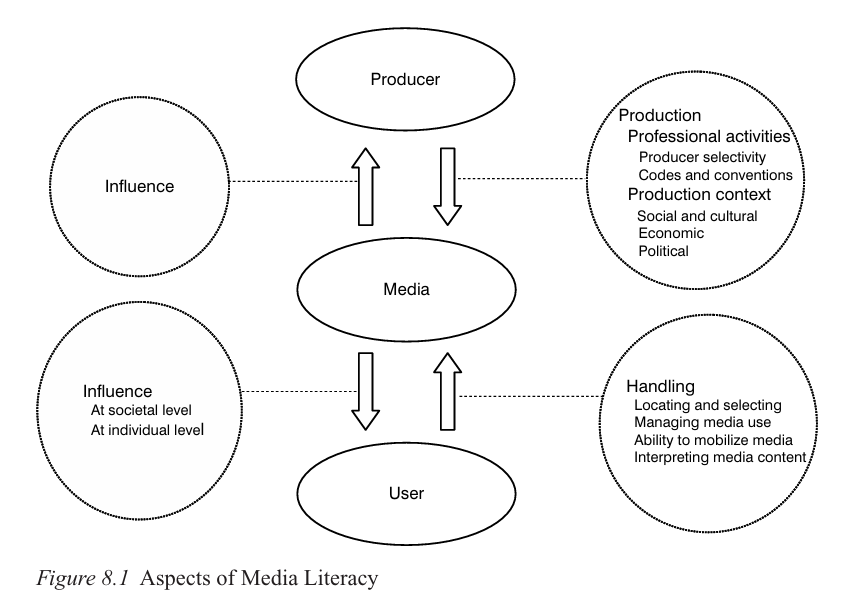
In 2010, Hans Martens remarked that media literate individuals “take an active rather than a passive role in acquiring new knowledge and skills” (p.6), aligning with my own perception of what media literacy means; to me, I find myself drawn to primarily the last two bullet points. That is how media influences consumers and how we as consumers handle this manipulation.
A recent TikTok appeared on my FYP from Thomas Pearson, which discussed this anti-intellectualist persistence via platform comment analysis, linked here; in the video, Pearson remarks how “It’s the raw, unfiltered bone-headedness that annoys” him, done so due to overconfident criticisms which are superficial and suggest users misinterpreted meaning.
Now, of course, meaning is often subjective but when content is distributed, there is an intended meaning by the producer encoded within its composition. While users can decode content in many ways, interpretations can be compromised depending on factors such as cognitive bias.
Thomas continues by saying these individuals will misremember facts and maintain their erroneous state when corrected by someone else; perhaps this is due to some sort of warped self-fulfilling prophecy, where the person in the wrong may believe that if they convince enough people they’re right (despite evidently being false), others will flock to their side.
A good definition regarding self-fulfilling prophecies is by Robert K. Merton, where he depicts it as:
Pearson continues on saying how this tunnel vision progresses via video misinterpretation, missing contextual clues and becoming infuriated by how their perception has caused them to perceive the content in a certain way. He depicts the current situation as “the Dunning-Kruger Olympics”, with this analogy ironically reflecting a broader societal issue.
That being what I will coin as macro-verbal amplification; in other words, because of the ability to communicate in a plethora of channels and doing so in an efficient manner, our opinions disperse so fast that it either becomes diluted (e.g – misspellings/typos) or prejudiced. This speed mirrors that of content consumption in our current times; we expect it to be fast, easily understood and to resonate with our tastes.
But in doing so, we are passive passengers traversing what is known as the ‘attention economy‘, coined by Richard Lanham in 2006; here, he disputes the idea of an information economy, as “information is not in short supply…What we lack is the human attention needed to make sense of it” (p.11).
In regards to dilution, the impact of our opinions weaken as we produce less credible and contradictory statements, especially in fields we know very little about (e.g – a psychologist giving advice about geography despite having no experience). A linguistic term related to this is semantic bleaching/weakening; this is where a word’s original meaning becomes reduced in influence over time.
For example, imagine I published a post on X stating “I think that Media Studies is the most important A-Level”. After doing so, the post gains some traction but not much. Then, I continued to push this agenda, but after a certain point, people began replying to my post with comments criticising my take, perhaps calling out my inability to justify this.
In fact, it became so overwhelming that I struggled to back this up with logical reasoning or evidence of my own. I chose to ignore this and continue putting out more messages, to gain more notoriety. However, because of this, my opinion would be deemed weaker.
For reference, while I do think it is quite an important subject to study due to the prevalence of media within our lives, I wouldn’t say it is the most important.
Moving on, Pearson iterates that the general mood is that people deem being loud as more important than being correct. He then suggests that these people believe being wrong is deemed a “personal defeat rather than a normal part of learning”, opposing constructivist methods of how we approach knowledge.
After, the post then addresses an infamous phenomenon which is continuously being regurgitated online by many users: anything that is deemed sophisticated, artistic or abnormal was done so by AI.
Thanks to my COMM113 Lecture on Monday contextualising digital and social media – alongside a YouTube short by etymology_nerd linked here – I have now become aware of the Dead Internet Theory; this is the belief that most users which are currently sifting through the endless digital streams of the web are merely bots and AI actors. Performative computation, if you will.
According to Adam Aleksic – the linguist behind persona etymology_nerd – the reason Instagram’s repost button & the location map exists, alongside revealing what reels people like is to maintain the illusion that the platform has high levels of real user engagement. It was revealed through Forbes’ research that 71% of social media images are now made from generative AI.
It seems that the reality is far more dire, as Aleksic reflects on how users initially migrated to Instagram for social interaction, until randomised feeds and low-quality ‘slop’ tarnished our experiences. Katty Kay from the BBC identified in July 2025 from polling results that nearly 1/3 of social media users post less than they did in 2024; this is partly due to not just the inclusion of AI but the shift in how the platforms and their creators operate.
An important case study we should consider is that of HouseFresh, where Google’s algorithm amplified and then decimated their network traffic, diminishing visitor amounts to just hundreds after their former glory. Moreover, the presentation of AI-generated answers from search results will not only streamline the required response but often make specialised websites redundant.
After all, why would casual users want to search article after article for an answer when Microsoft Copilot told them in a matter of seconds? Once again, the attention economy is in full swing.
Nowadays, we all can’t help but think everything is artificial intelligence, what with the proliferation of generative content, deepfakes. We can also see advertising employing AI tools, such as a recent YouTube advert I saw from Alpecin. I will leave a link here.
The video states “Grey looks old”, immediately enforcing an ideological stance onto the viewer through a fixed lens; it induces the subliminal messaging onto the viewer that if they have grey hair, then this is a negative quality (reinforced by the AI male with a sad facial expression).
We can imagine this through Boolean logic:
AND
| G (Grey) | O (Old) | X (True/False) |
| 1 | 1 | 1 |
| 0 | 1 | 0 |
| 1 | 0 | 0 |
| 0 | 0 | 0 |
The following condition states this:
Grey AND Old must both be true conditions in order for the statement to be true. In other words, the statement “Grey = Old” is only possible if both Grey and Old are true.
NOT
| G (Grey) | O (Old) | X (True/False) |
| 0 | 0 | 1 |
| 1 | 1 | 0 |
The following condition states this:
Grey AND Old must both not be true conditions in order for the statement to be true. A way I like to remember NOT is opposites attract.
For more on Boolean Logic, check out this link.
You may be wondering why I even went to the effort of representing this through logical statements. Well, that is because the advert offers no alternatives perspectives. After all, I’m sure there are plenty of men and women out there with grey hair who feel empowered and are not ashamed of their older appearance.
But Alpecin conforms to the dominant advertising approach of endorsing experiences and lifestyles, rather than products. How else would they be able to acquire consumer investment? The shampoo is marketed via the emotive base adjectives of “darker” and “stronger” regarding the consumer’s hair after usage; this juxtaposes the vulnerable state of supposedly those with grey hair, as Alpecin have the solution by inspiring their customers.
All of these elements are designed to entice us into purchasing, whilst also force us into submission through the sloppy implementation of AI resourcing. In doing so, we often lose the social interaction that once pioneered these platforms, as adverts pervade them and critical thinking becomes so hard to maintain that we become resentful and stubborn.
As stated above, if you would like to educate yourself on media literacy, check out Crash Course’s playlist, would highly recommend.
Any questions? Feel free to contact me on johnjoyce4535@gmail.com!
Check out my last piece: Authors of Time – The History of Journalism
Or why not check out my website! I published a blog called Linguistics: 101, serving as an introduction to linguistics.
For more opinion pieces, click the following link:
https://www.liverpoolguildstudentmedia.co.uk/category/opinion