
6th November 2023

Listen
Listen

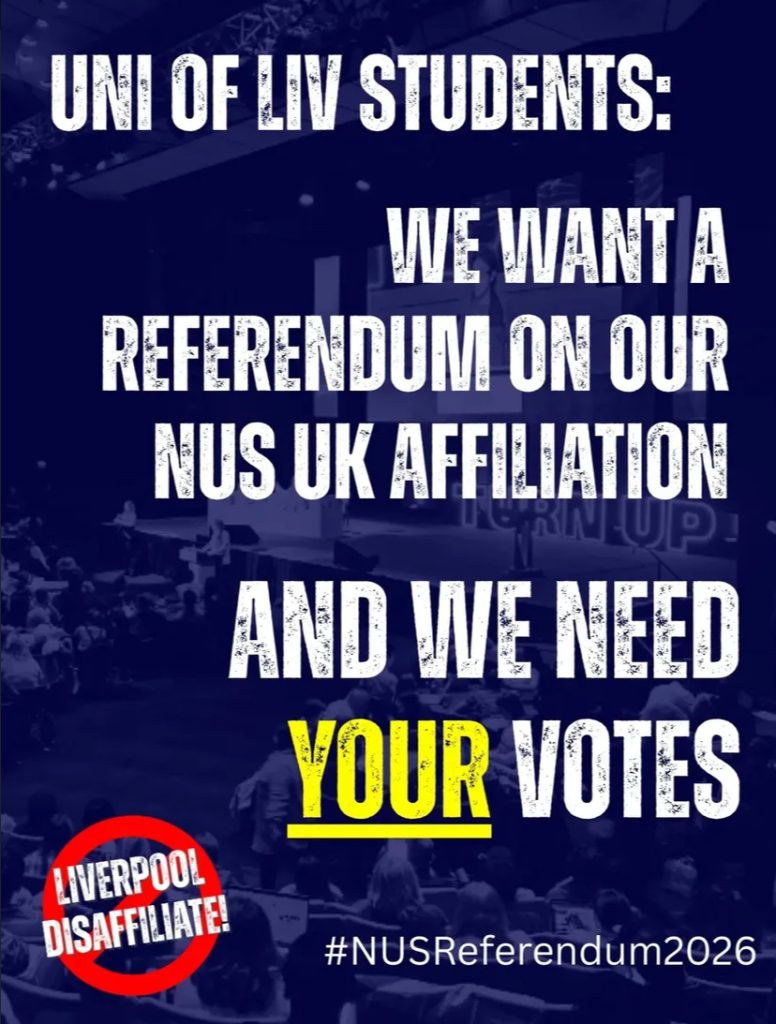
An Instagram account named uol.disaffiliate is encouraging University of Liverpool students to vote for a referendum against the Guild’s relationship with NUS UK. The National Union of Students is an organisation formed of 2 distinct subdivisions (NUS Charity and NUS UK) designed to represent the UK’s college and university students, stating that it intends to “achieve national change for students”.
NUS Charity is a membership organisation supporting the Guild through training, resources and general guidance; meanwhile, NUS UK is the student-led side that contain NUS officers and campaigns lobbying for students. The petition was submitted by Finlay Deane and seconded by Daniel Horton as a call to action aimed at disaffiliating with NUS UK, not NUS Charity; according to Deane, “Our NUS, which was once a force for good, is broken” due to “threatening student officers who spoke up on Palestine” and “limiting grassroots participation in decision-making”.
He believes that NUS UK has become “authoritarian and financially driven”, which has forced this need for reformation. The Guild spends £39,904 for support and access to services provided by NUS Charity and NUS UK, being its highest contributing affiliation; specifically, £30,700 is spent for NUS UK. The money is spent on national level campaigning – such as winning maintenance grants or protection for students in the Renters’ Rights Act. For a guide to the Renters’ Rights Act, click here.
We can see other societies within the Guild standing in solidarity with this defiance on Instagram, such as the Palestine, Feminist, Arab, Film, Sudanese and Rock societies. Moreover, many students I had spoken to expressed major concern for the situation, with a fellow media student in my class named Kat stating that a “guild is meant to advocate for students and their interests and thus, one that doesn’t cater for student welfare and interests is not by definition a guild“.
Continuing on, the account has reposted stories, comprised of user presidentothman remarking how “The NUS has refused to take a pro-Palestine stance through almost two years of genocide, and is a waste of our students’ money” and that it is “TIME TO LEAVE THE NUS”.
Disclaimer: Before we get into exploring both sides of this debate, my advice would be to consider the perspectives and determine where you stand, using this article as a jumping off point to do additional reading on the matter being addressed. Never take things at face value, as the world doesn’t always work in simple binaries of good vs bad.
To comprehend the full extent of the situation, I think we must consider the historical context of the NUS. Founded in 1922, the NUS’ initial ambition was “To represent past and present students from a national and international point of view”. Their first Executive Committee meeting took place on 11th February 1922 in London, with their second occurring between 31st March-2nd April.
The first notable form of unionisation was between 4th-12th May 1922, where students partook in ‘strike breaking’ during the miner’s strike, with some from established Socialist societies supporting these workers. After, in 1933, international conflict led to a feud due to the CIE Congress at Vienna refusing to condemn Fascist organisations; this made the NUS withdraw and for them to provoke a debate on whether students would fight for “King and Country”. This followed a successful debate at the Oxford Union, where the house decided they wouldn’t.
The next important action was in 1939, where the NUS joined a “Parliament of Youth” by calling for a form of comprehensive education. Student Congress at Leeds forged a ‘Student Charter’, containing student rights and responsibilities; this meeting had also condemned imperialism, private wealth and WW2. NUS Trustees attempted to close NUS down but were unsuccessful. In July 1940, the NUS elected its first female president of Mary Corsellis but she lost a re-election in October 1941.
In 1942, at NUS Congress, 1,500 students globally pledged to build a better world and in 1943, the NUS called for discussion on university reformation, diverse teaching methods and staff (to back this up, former NUS president Brian Simon published a book titled A Students view of the Universities, outlining many core NUS policies).
After, in 1946, the International Union of Students formed in Prague. In 1952, Sheila Davis (President of Bangor Normal Training College) was expelled for publicly criticising the college’s disciplinary code; the NUS supported her by initiating a letter-writing campaign to MPs, with the issue being the subject of adjournment debate. The Minister of Education admitted the college were at fault and Davis had won.
In 1956, the NUS provided support for exiled Hungarian students after the Soviet invasion, with Cardiff students marching throughout the city in protest against said invasion. Moreover, in 1960, the Cardiff University Student Union voted to boycott South African goods to combat apartheid. Then, in 1972, an agreement was signed between the NUS and Union of Students in Ireland; this was in concern over the dual membership of students’ unions in Northern Ireland, leading to the establishment of NUS-USI. In 1975, NUS became the first prominent UK organisation to officially recognise Welsh.
It wouldn’t be until 1977 that a woman would take the office of President via Sue Slipman, who had previously been National Secretary and thus the first female sabbatical. In 1978, Trevor Phillips was elected as the NUS’ first black leader. In 1987, the NUS’ Boerclaybank campaign encouraged Barclays Bank to withdraw from South Africa, designed to be a stepping stone in stopping apartheid.
In 1999, a huge debate concerning reformation of the NUS transpired, launched at Annual Conference; it was supposed to be an opportunity to look at modernising the student movement. In 2013, the NUS secured £5 million from HEFCE (Higher Education Funding Council for England) to support sustainability projects around England. In 2016, NUS provided legal advice to help the courts determine that 48,000 international students were wrongly deported by the Home Office using a flawed English Language test.
More recently, in September this year, the NUS were able to win the return of maintenance grants, which will provide “extra financial support for eligible higher education students from low-income households”. These new grants will be introduced between 2028-2029 as an addition to maintenance loans (giving students extra funding while studying without increased debt) and will be available for both new students and those in later years of study, as long as they are eligible. For more information on these grants, click here.
But, it’s not just uol.disaffiliate. There was a post from 25th November by the account not.my.nus, where they state how the “NUS claim to support Palestinian liberation”. However, they have instead “left us alone in this fight, and now an international student [Usama]’s life is at risk” of deportation to Egypt for his pro-Palestine activism. It claims that the NUS conference on November 20th had included Palestinian ambassador Husam Zomlot to “whitewash their ongoing inaction and complicity” rather than “inspire their advocacy”.
The account goes on to suggest that the leaders of NUS are “watching from the sidelines” despite having the “role and power to amplify” students’ voices, with their actions being “draconian” (extremely cruel and severe). They have tasked students to embrace a participatory culture and tag @NUS_UK, @amiranuspres, @alex_nusvphe and @saranya_nusvplib to demand they step in as representatives.
Moreover, they seek a public denouncement of King College London’s actions and for safeguarding measures to be implemented regarding Usama and other activists on campus. Their tagline appears to be “Tag NUS, join the phone blockade, and demand KCL management reinstate Usama”. The account also asks that students read off a pre-written script whilst calling KCL, which they should record and tag their account @asapalestine in.
Then, uol.disaffiliate referenced Cambridge’s disaffiliation with NUS UK and divestment via a post from the university’s Palestine Solidarity Society. This took the form of 2 votes: one for disaffiliation (1172 voted for YES) and another outlining a request to end investments with institutions involved in occupation and weapons manufacturing (3241 voted YES).
The Cambridge Student Union website contains more information on their referendum, which took place between Monday 27th October and concluded on Thursday 30th at 5pm. Below, I will explain how this referendum took place.
Current Cambridge student members could vote in an online ballot, offering the options of YES, NO and ABSTAIN. The referendum’s quorum (smallest number of people needed to be present at a meeting for decisions to be made by voting) was 2000 votes.
The first question concerned disaffiliation, asking if Cambridge SU should disaffiliate from NUS UK. According to the votes, there were 1772 for YES, 1284 for NO and 719 for ABSTAIN.
The second question asked if Cambridge SU should campaign to end university investments and collaborations with institutions involved in occupation, genocide, surveillance and weapons manufacturing. Their policy motion detailed how under international law that both States and Corporations must prevent genocide, referencing Israel’s actions in Gaza. There were 3241 votes for YES, 615 for NO and 167 for ABSTAIN.
Overall, 4070 students voted in the SU Referendum.
More recently, Finlay has provided another Instagram post which takes a more satirical look on the situation. This is done through the on-screen graphic design of an error message, which reads “ERROR 404: Democracy not found”. According to the post, the NUS scrapped democratic conferences to prohibit students from participating. To combat this, he is once again reiterating to students to sign the petition. Furthermore, he created a mobile tutorial on how to aid the cause, a comparative post of the NUS in the 1970s to now and an on-campus video.
To gain both perspectives on the matter at hand, I reached out to the NUS to offer an official statement. In doing so, Amira Campbell, President of the NUS, had this to say:
“Together with NUS, students at Liverpool can affect national level change which benefits current and future students. Recent advocacy by sabbatical officers through the APPG (All Party Parliamentary Group) for Students, supported by NUS, led to an amendment to the Renters’ Rights Act to stop the rush for student housing getting earlier and earlier in the year.
And in September, after over a decade of campaigning, we won the return of maintenance grants – that is money in the pockets of students because a united student’s movement was relentless.
We hope to continue working with Liverpool Guild, and are always open to conversations with your sabbatical officers about the issues affecting students and what we can work together on.”
Back in May 2021, the NUS issued a statement on X expressing their solidarity with Palestinians by recognising it as a genocide. Additionally, NUS Australia’s annual National Conference in 2023 passed a motion, where they stood in solidarity with Palestine.
156 delegates represented 23 university campuses across Australia, with National Education Officer Xavier Dupé stating “As bombs rain down on civilians in Gaza, the National Union of Students has staked out our opposition to this vile genocide”. Furthermore, national LGBTI+ Officer Grace Hill asserted that the motion “makes it clear that the National Union of Students stands with the millions who have been taking to the streets for Palestine all around the world”.
Moreover, I invited Finlay to partake in a structured interview on Tuesday 2nd December. The following questions were prepared beforehand, but some responses may be inaccurate due to timing (e.g – discussion about the marketing campaign):
Yes. I was one of the delegates for Liverpool Guild at the last ever all-member conferences. There was a heated discussion about the ongoing genocide in Gaza and how the NUS should articulate itself. There was an overwhelming sense in the room that the NUS should fall in line with the growing global consensus that it is, in fact, a genocide.
We also wanted a guarantee from the NUS that they would protect student officers and activists from intimidation from anti-BDS activists and organisations like Lawyers for Israel. Instead, the NUS omitted all of our amendments the following day. In response, around 100 of us walked out of the conference and held a spontaneous fringe. That’s where this campaign began, really. But there are many reasons to leave.
We’ve had an outpouring of support from societies who are only just learning exactly how much money we are spending on the NUS. £30,700 to be exact. We want that money put back into where it matters.
None of us really know why Liverpool Guild spends as much as it does on the NUS. Many people don’t know that in 2019, the NUS nearly went bankrupt and was split into two parts: NUS Charity and NUS UK.
One theory is that student unions like us are pumping grotesque amounts of money into the NUS just to keep it chugging along. But if the NUS can’t manage itself, then frankly, we should let it fail on its own.
I wish there was a way we could reconcile with the NUS, but unfortunately, we have already tried. I’m a strong believer in democracy, solidarity, and justice. For me, this is tragic.
But if the NUS wants to attack sabbatical officers for condemning the genocide in Gaza and abolish its conferences so that regular students like you and me don’t have a say, then what’s the point in it?
The NUS has reached out to discuss this campaign with me, and I declined.
It’s simple: the cost. While we’ve been out campaigning, we have found that many students don’t actually know what the NUS does. So when we explain to them just how much we spend, it’s shocking to them.
In terms of our campaign, if that’s what you’re referring to, students can expect to see us around campus for the next two weeks. We want to speak directly to them, answer their questions, and, importantly, get the 1000 signatures we so desperately need.
We have requested a small extension to account for the late start we had, but due to the term ending, we might not get it.
If we are successful, it’s not up to us where the money goes. But we would like to see it distributed across student campaigns. For example, addressing period poverty, sustainability campaigns, etc.
And of course, societies have to benefit from this as well. I used to sit on the mini Spend-It committee, where we would process funding requests from societies for various things, like trips, equipment, etc. An extra £30,700 would go a long way, trust me.
Finally, to students: help us get this referendum by signing the petition on the Guild website! It takes less than one minute, seriously, we checked. The NUS has taken advantage of our funding and your ignorance for far too long.
We deserve a voice, and the NUS hates that. So show them and vote!
The Guild writes that according to the Liverpool Guild of Students’ Articles of Association and Bye-laws (pg.12), if at least 3% of the Guild’s members sign a petition, then a referendum will be held. Due to bye-law requirements, any referendum requires at least 5% of the Guild’s members to cast a vote in the referendum for it to be passed (pg.12).
As of writing, the petition closed at 2pm on 12th December, resulting in 1003 supporters.
The Guild has declared that after a careful signature review, the petition has achieved over the required quoracy of 3% (947 students), verified by the Returning Officer. Because of this, a referendum will be held regarding the petition and its subject matter.
For any questions regarding the petition update and next steps, contact democracy@liverpool.ac.uk.
In 2026, a formal callout for campaign teams will occur and a voting period will take place between 9am Monday 23rd February-10am Thursday 26th February.
If you’re interested in starting your own petition, check out the Guild’s democratic guidelines.
Any questions? Feel free to contact me on johnjoyce4535@gmail.com!
Check out my last piece: Etched Into Our Memories – The Unified Lara
To read more about what’s happening on campus, check out the following link:
https://www.liverpoolguildstudentmedia.co.uk/category/on-campus
Liverpool Guild Student Media does not endorse any campaigns in regards to the NUS.